Abu Dhabi museum lets visitors touch a fragment of the Moon
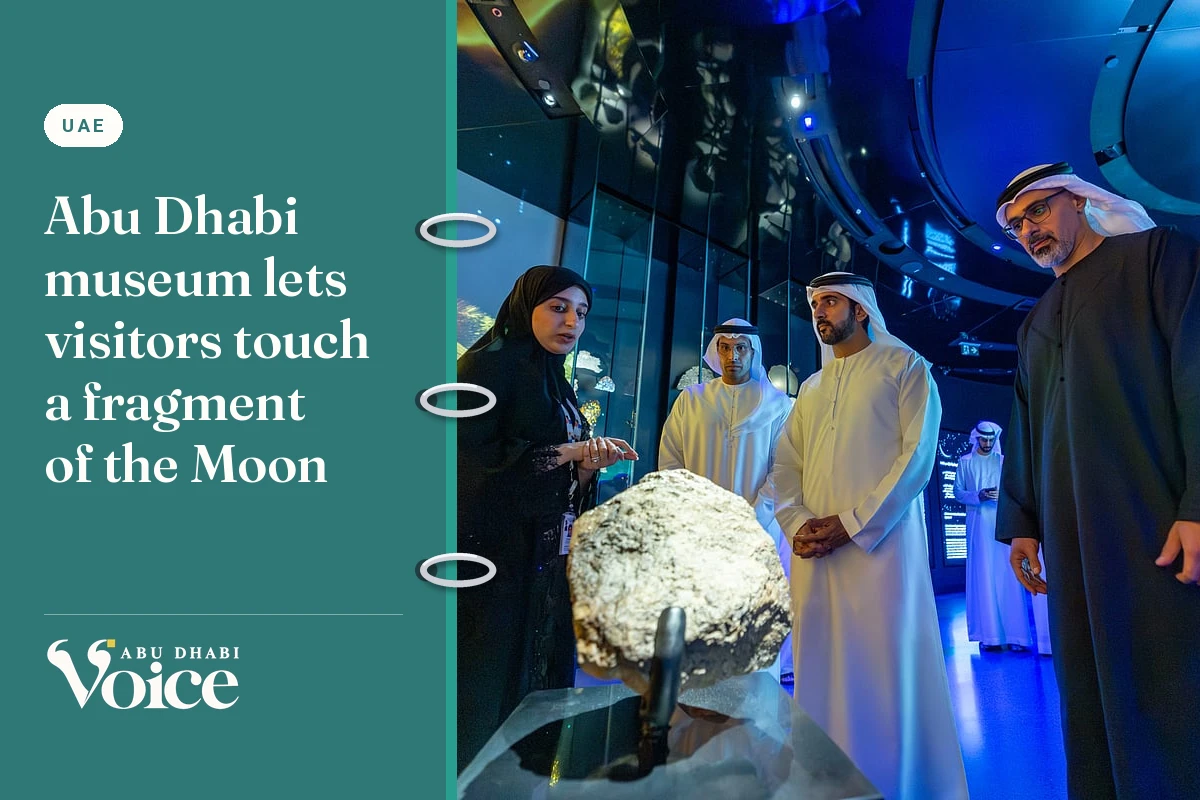
Walking into the Natural History Museum Abu Dhabi means confronting a piece of the Moon you are allowed to touch. The lunar fragment, labelled Ash Shaqqah 002, sits in the Story of Earth gallery. A short caption next to it recounts how an asteroid knocked it off the Moon’s surface, Earth’s gravity eventually pulled it down, and it came to rest in the Libyan desert, where it lay unrecognised for a very long time until its origin was confirmed in 2024. The museum describes it as the largest piece of the Moon that a human hand can physically reach. The display itself is deliberately minimal: a cold rock, a visitor’s hand, and the slight dizziness that comes from knowing where that rock has travelled.
The museum’s story
The Natural History Museum Abu Dhabi opened in 2025 on Saadiyat Island. It is the biggest institution of its kind in the Middle East, covering 35,000 square metres of galleries, laboratories and public spaces on a site of 82,000 square metres. The Dutch architectural firm Mecanoo designed it between 2020 and 2022, and construction took the next three years.
The museum traces the natural world from the Big Bang to present-day challenges such as climate change. Visitors can follow the timeline from beginning to end. The journey starts in The Story of Earth, which features a glowing model of the Sun and meteorite displays. Here visitors can touch Ash Shaqqah 002.
Dinosaurs, ancient elephants and human ancestors
The Evolving World gallery houses dinosaurs. Its star is Stan, a Tyrannosaurus rex that died 67 million years ago. The museum calls him the last ruler of the Cretaceous period and says scars on his skull came from a fight with a larger T. rex over a Triceratops carcass.
The Lost World of Abu Dhabi focuses closer to home. It presents a reconstructed Stegotetrabelodon emiratus, a four-tusked elephant that lived in the emirate seven million years ago. The exhibit describes a herd that moved together and looked after its members, showing that the animal’s social bonds and appearance were traits passed on to modern elephants.
Human Story covers human evolution. Its best-known specimen is Lucy, an Australopithecus afarensis who lived 3.2 million years ago. An international team led by Professor Donald Johanson found her in Ethiopia’s Afar region in 1974. Her skeleton proved that she walked upright on two legs, which changed the understanding of human ancestors. Her name derives from a Beatles song.
Biodiversity, planet resilience and a hillside-like building
Our World focuses on biodiversity with immersive displays. A blue whale skeleton hangs above an underwater scene. The whale can grow to 30 metres long and weigh nearly 200 tonnes; it feeds on krill and migrates thousands of kilometres each year between polar and tropical waters.
Resilient Planet, the last main gallery, addresses environmental issues and the challenges Earth currently faces.
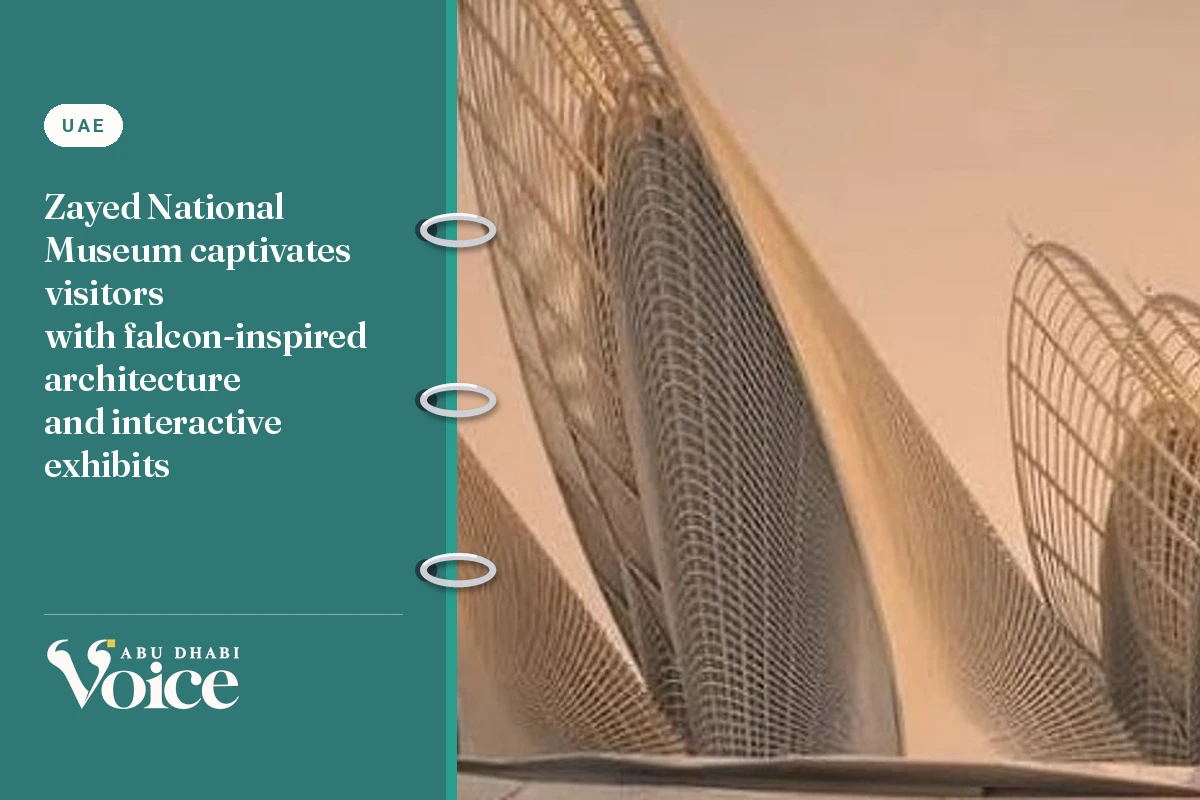
From the outside, the museum barely resembles a building. Mecanoo shaped it as a cluster of sculpted volumes inspired by the region’s geology and dry riverbeds, or wadis. Pentagonal patterns running through the design come from cell structures found in living organisms.
Three public paths cross the grounds, connecting the waterfront with nearby cultural institutions. These walkways are free and open to anyone, with or without a ticket. Visitors can explore the museum’s landscape without ever entering a gallery.
Inside, the entrance lobby is carved like a void from the building’s mass, with deep skylights letting in shafts of daylight. The effect resembles descending into a rock formation rather than entering a hall. Next to the galleries is the Immersive Theatre, which requires a separate ticket.
The museum also runs research laboratories working in palaeontology, geology, marine biology, entomology, earth sciences and molecular research, including ancient DNA and proteomics. The director is Peter C. Kjærgaard, who has led several major natural history institutions in Europe.