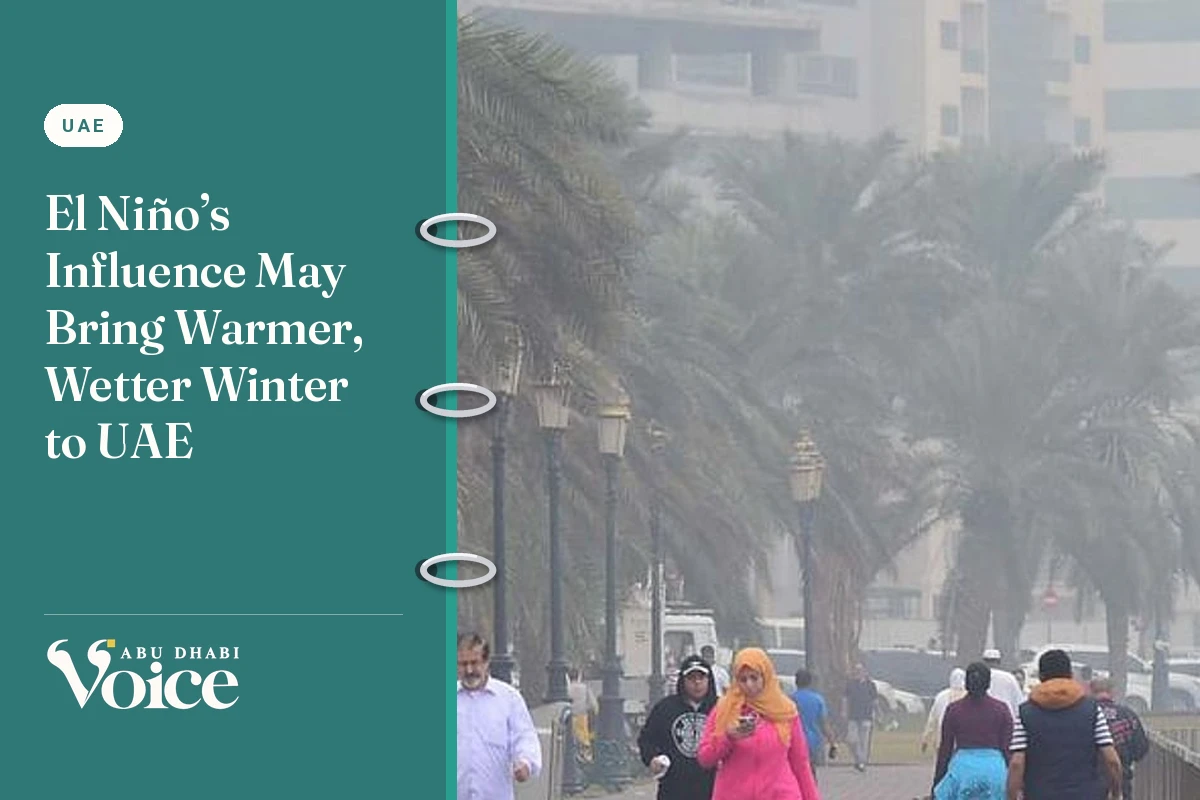
El Niño’s Influence May Bring Warmer, Wetter Winter to UAE
The National Centre of Meteorology (NCM) says a very strong El Niño is expected to develop in the tropical Pacific, with a 96 percent chance of persisting from November 2026 through March 2027, and that this could lead to a UAE winter that is warmer and wetter than usual.
El Niño forecast and strength
El Niño forms when large areas of the tropical Pacific Ocean become unusually warm. Forecasts indicate the phenomenon will reach very strong levels in October and November 2026, with the Niño 3.4 index already at 2.3 °C above normal and climate models suggesting it could approach 3 °C. Under the NCM’s classification, an anomaly above 2 °C places the event in the very strong category. These figures describe how much warmer the Pacific is compared with its long‑term average, not the expected temperature rise in the Emirates.
The centre’s report gives a 96 percent probability of El Niño conditions between November 2026 and March 2027. This probability refers to the oceanic pattern itself, not directly to the chance of heavy rain or flooding in the UAE.
What this means for UAE weather
Researchers at New York University Abu Dhabi have found that El Niño years tend to strengthen flows of atmospheric moisture from the Red Sea and Arabian Sea toward the Arabian Gulf. When combined with shifts in upper‑level winds and passing weather systems, this extra moisture can create conditions favourable for rainfall across the Emirates.
The NCM’s seasonal outlook expects rainfall between November and March to be near or above seasonal averages, though it does not quantify the additional amount or suggest that rain will fall more often on a day‑to‑day basis. A wetter season could result from a few intense downpours even if many days stay dry, and rainfall totals can vary sharply from one location to another.
Temperatures across the Emirates are also forecast to be near or above seasonal averages, which could make the winter feel warmer overall while still allowing for cooler days and nights.
Historical extreme rainfall context
The possibility of heavier rain evokes the event of 16 April 2024, when the UAE recorded its heaviest rainfall since meteorological observations began in 1949. The NCM measured 254.8 mm of rain at Khatm Al Shakla in Al Ain in less than 24 hours, with several other areas experiencing exceptionally heavy downpours that flooded roads, disrupted flights and brought parts of Dubai and other emirates to a standstill.
Studies of that April 2024 episode attribute the intensity to a mix of powerful atmospheric disturbances, abundant moisture and unusually warm surrounding seas. While El Niño can influence the broader climate setting in which such storms develop, it cannot by itself explain or predict an individual extreme weather event, and a very strong El Niño should not be taken as proof that another record‑breaking flood is imminent.
Advice for residents and outlook
The NCM notes that significant weather activity is possible toward the latter part of the forecast period, so residents should pay close attention to updated forecasts as winter transitions into spring. Motorists are advised to heed official warnings during unsettled conditions, avoid flooded roads and wadis, and allow extra travel time when heavy rain is expected.
The centre will continue to monitor El Niño and revise its assessment each month as new ocean‑temperature readings and climate projections become available. For now, the outlook points to a winter that could be warmer and wetter than usual, with a chance of more notable weather later in the season, while the exact amount of rain, its geographic focus and whether the necessary atmospheric conditions for a major storm will align remain uncertain.