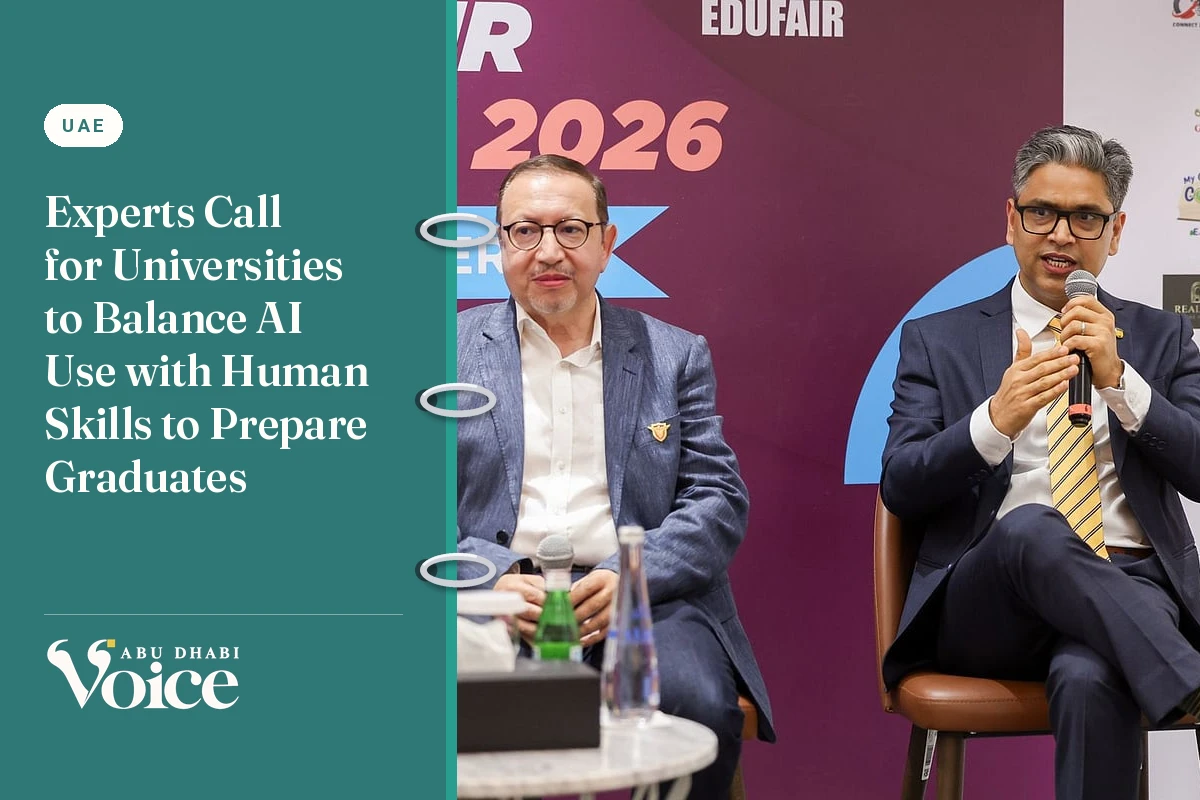
Experts Call for Universities to Balance AI Use with Human Skills to Prepare Graduates
Experts at Edufair Abu Dhabi said that artificial intelligence, internships and interpersonal abilities are essential for preparing students to enter the workforce, calling on universities to rethink teaching methods and assessment practices.
Rethinking University Teaching for the AI Era
They noted that as AI and other technologies become widespread in higher education, students must learn when and how to use these tools without becoming dependent on them, and that universities should guide learners to apply technology with judgement while fostering independent thinking, communication, teamwork and problem‑solving, calling for a rethink of educational approaches with greater emphasis on interactive teaching, practical assessments and flexible study options.
Dr Mishra pointed out that case‑study discussions and oral examinations can serve as alternatives to relying solely on written assignments, adding, “We cannot stop students from using AI, so we have to find new solutions.”
The panellists stressed that alongside new forms of assessment, universities must link academic learning with the competencies required in the workplace.
Linking Classroom Learning to Workplace Skills
Prof. Zeid explained that at Thumbay, AI is taught across disciplines in healthcare education to help students grasp its applications, and that learners need to move beyond basic concepts and keep up with emerging technologies. He said, “The key is to create lifelong learners who can continue to adapt as new technologies emerge.”
He added that internships at health‑tech firms, hospitals and other healthcare organisations give students a chance to put their knowledge into practice.
Dr Mishra noted that employability depends on more than academic qualifications, urging universities to monitor industry demands and embed relevant skills into curricula, even if programme revisions take time. He said, “Students today are more interested in practical learning than simply memorising definitions and theories. That is why practical experience and internships have become important components of university education.”
Beyond Academics: The Value of Practical Experience
While acknowledging that AI can aid information access and concept comprehension, the panellists emphasized that university life must also nurture skills through human interaction and collaboration.
Prof. Zeid observed that hackathons and innovation competitions bring together students from different fields, fostering leadership and teamwork abilities. He stated, “AI can teach the course material, but it cannot teach empathy or make you a leader. Those human connections happen through interactions with other people, and that is an essential part of the university experience.”
Dr Mishra highlighted that learning extends beyond the classroom through mentoring, academic advising, student clubs and event organisation, which help develop communication, time management and teamwork skills not always covered in formal courses. He remarked, “I tell students that what you learn in the classes is only 50% of what you should learn. The other 50% comes from outside the classroom.”
The panellists advised prospective students to look beyond a programme’s academic content when selecting a university, considering practical opportunities, the learning environment and the skills they can acquire.
Dr Mishra noted that UAE universities now offer programmes across disciplines, with AI and machine learning growing in relevance outside engineering, including in the humanities, social sciences and design. He concluded, “When choosing a university, students need to look carefully at the institution and the programmes it offers, and consider whether the education will equip them with the skills they need for the future.”