Experts Call for Universities to Blend Human Skills with AI Training at Edufair Abu Dhabi 2026
At Edufair Abu Dhabi 2026, education specialists warned that artificial intelligence will reshape workplaces, making human abilities such as communication, judgment and collaboration increasingly vital.
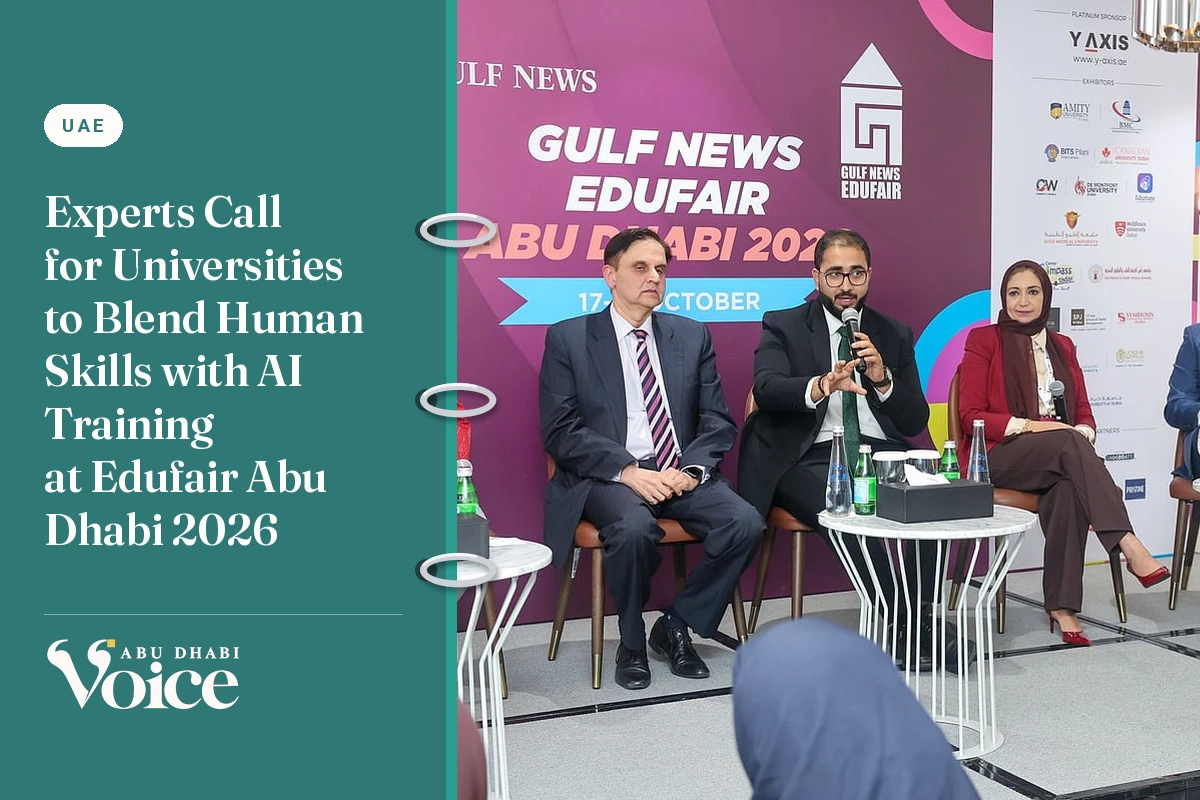
Human Skills in the AI Era
During a panel discussion, Dr. Anita Patagar, Executive Director of Symbiosis International University Dubai, observed that many academics and universities remain locked in disciplinary silos while the real world operates across boundaries. She said, “Many academics and universities tend to look at disciplinary boundaries and silos. The world doesn’t, but universities do.”
Panellists stressed that communication, judgment, curiosity and collaboration must sit alongside disciplinary knowledge and workplace experience as institutions prepare graduates for evolving careers. They added that while AI and digital tools can automate parts of a job, technology cannot replace the professional comprehension, curiosity and interpersonal abilities needed to interpret information, make sound decisions and work effectively with others.
Embedding Technology Across Disciplines
Dr. Vishnu, Program Director (LLM) and Assistant Professor at the College of Law, University of Dubai, defended the core discipline, stating, “One thing I want to defend is primary discipline, the subject that you have, to the foundation that’s still needed. AI would replace, some of the tasks we largely do. said Dr. Vishnu, Program Director (LLM) and Assistant Professor at the College of Law, University of Dubai”. He then cautioned, “But you need to have the substance to ensure that AI wouldn’t replace you,” he added.
The speakers reiterated that graduates still require a strong grounding in their chosen field, but must also grasp adjacent subjects well enough to see the broader picture, communicate across professions and tackle problems that do not fall neatly within a single discipline.
Patagar suggested that universities could cultivate this breadth through cross‑disciplinary study, industry projects and exposure to areas such as sociology, psychology and economics. She elaborated, “I think the understanding is very simple: you won’t be able to grow. You’ll survive, but you won’t be able to grow unless you’re able to see everything in context,” she added.
The discussion concluded that the goal is not to water down specialist knowledge but to help students link it to people, organisations and society.
According to Dr. Umesh Kathari, Assistant Dean and Assistant Professor at the S P Jain School of Global Management, technology should be woven into existing degree programmes rather than isolated as a separate track. He remarked, “we don’t need to have technology as a separate vertical similar to sustainability.” and added that its integration must occur in every discipline, noting, “Disciplines of business, maybe marketing, finance.” He also pointed out that in sectors like marketing and finance, students must learn to understand analytical tools, interpret their outputs and explain what the findings mean for a decision.
Practical Learning and Industry Links
Healthcare was offered as a clear example of why technical and human capabilities must develop together. Dr. Riham Ahmed Ibrahim, Associate Professor and Chairperson‑in‑charge of the Pathology Department at RAKMSHU, explained that AI-assisted diagnosis can require clinicians to work with engineers, legal experts and managers, while also navigating questions about authorisation and liability. He added, “Nowadays we are working closely with AI techs and engineers to develop very important AI-assisted tools for diagnosing disease, for managing patients,” he added.
Panelists urged institutions to provide internships, industry projects, volunteering, workplace visits and assessments rooted in real situations so that students gain a clearer view of different roles before graduation. Mohammed Baraka, Vice President of the Dubai Campus of the Battery Medical College in Dubai, described a curriculum‑design approach that starts with labour‑market needs. He cited Pharmacy programmes as an example, noting they have incorporated AI applications in healthcare, digital health, informatics and digital pharmacy alongside practical exposure to hospital automation facilities and software companies. He said, “We send them to the automation facilities, big automation facilities in hospitals, and we send them to the software companies to learn about the new software that companies are developing for the medical field.” Dr. Baraka added.
Educators warned that keeping programmes relevant will also depend on lecturers and institutions adapting as quickly as industries do. For students, the advice was to look beyond the degree title and investigate the realities of a profession through reading, conversations with practitioners, volunteering and direct exposure to workplaces.
Students in the audience took the chance to pose questions to the panellists, marking the first day’s success of Edufair Abu Dhabi 2026.