Macron in Riyadh as Houthi attacks escalate; UAE welcomes IAEA nuclear plant review
French President Emmanuel Macron arrived in Riyadh on an unannounced visit Wednesday to show solidarity with Saudi Arabia amid a wave of Houthi attacks on the kingdom, as the wider Middle East conflict continues to fuel regional and global tensions.
The French presidency said the visit was intended to demonstrate France’s support for Saudi Arabia following repeated Houthi strikes on its territory and to press efforts to secure energy supplies.
Iran pushes back on international pressure
Iran’s Foreign Ministry spokesperson Esmaeil Baqaei on Wednesday rejected calls for the international community to condemn Tehran, arguing that Iran had been attacked twice in less than nine months while negotiations were still underway.
In a post on X, Baqaei accused those behind the attacks of killing children in Minab and young women in Lamerd, assassinating Iranian leaders and tightening sanctions on Iranians. He also said they had undermined a memorandum of understanding signed on June 17.
Baqaei argued that the conflict was contributing to regional instability and global economic insecurity. He said those who launched what he described as a “war of choice” could not portray themselves as victims or shift the blame onto Iran.
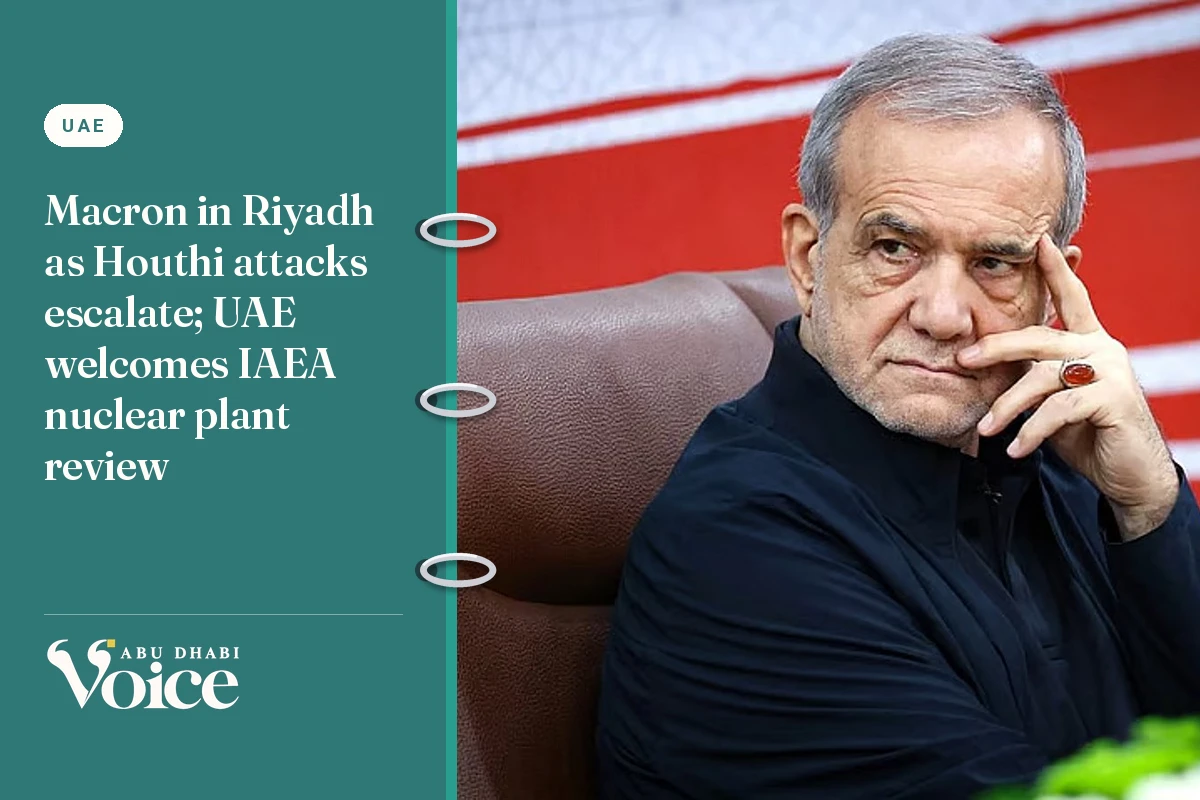
Iranian President Masoud Pezeshkian said the United States could not expect dialogue with Tehran while maintaining a blockade and threatening the country. In a post on X, Pezeshkian criticised Washington for increasing sanctions and pressure while simultaneously calling for negotiations.
“One cannot increase the intensity of sanctions and pressures every day, close the paths of interaction, and simultaneously speak of negotiation,” he said. “Dialogue with the language of threats and pressure has no meaning.”
US sends more forces to the region
The United States is deploying additional naval forces and thousands of military personnel to the Middle East as diplomatic efforts to avert another confrontation with Iran face a deadlock over Tehran’s nuclear programme. The deployments come as US President Donald Trump considers whether to resume strikes against Iran.
Yemen and maritime security
Yemen’s Houthis said on Wednesday that they had targeted a Saudi position in Aden, where smoke was seen rising near the airport. The attack was the third in a week on the seat of power of Yemen’s Riyadh-backed government, according to the report.
A ship was struck by an “unknown projectile” off the coast of Oman near the Strait of Hormuz on Wednesday, sparking a fire, according to the UK Maritime Trade Operations (UKMTO) agency. The tanker was about 11 nautical miles, or 20 kilometres, off the town of Bukha and was later reported to be at anchor. UKMTO said all crew members were safe and there was no reported environmental impact.
Iranian Foreign Minister Abbas Araghchi said on Wednesday that any intervention in Yemen’s war by Egypt or another country would make the situation more difficult. In an interview with Iraqi state broadcaster Al Iraqiya, aired on Tuesday, Araghchi said Egypt had sufficient experience to avoid becoming involved in what he described as a highly complex conflict. “We believe that any foreign presence or interference will only make resolving this issue more difficult,” he said.
UAE hails IAEA assessment of Barakah plant
Dr Anwar Mohammed Gargash, Diplomatic Adviser to the UAE President, welcomed the International Atomic Energy Agency’s positive assessment of the UAE’s response to a drone attack that disrupted external power supplies to Unit 3 of the Barakah Nuclear Power Plant on May 17, 2026.
In a post on X, Gargash highlighted the agency’s recognition of the UAE’s safety and emergency preparedness measures. He described the country’s peaceful nuclear energy programme as a model that serves humanity and contributes to regional security and prosperity.
Follow our live blog for the latest Middle East developments.