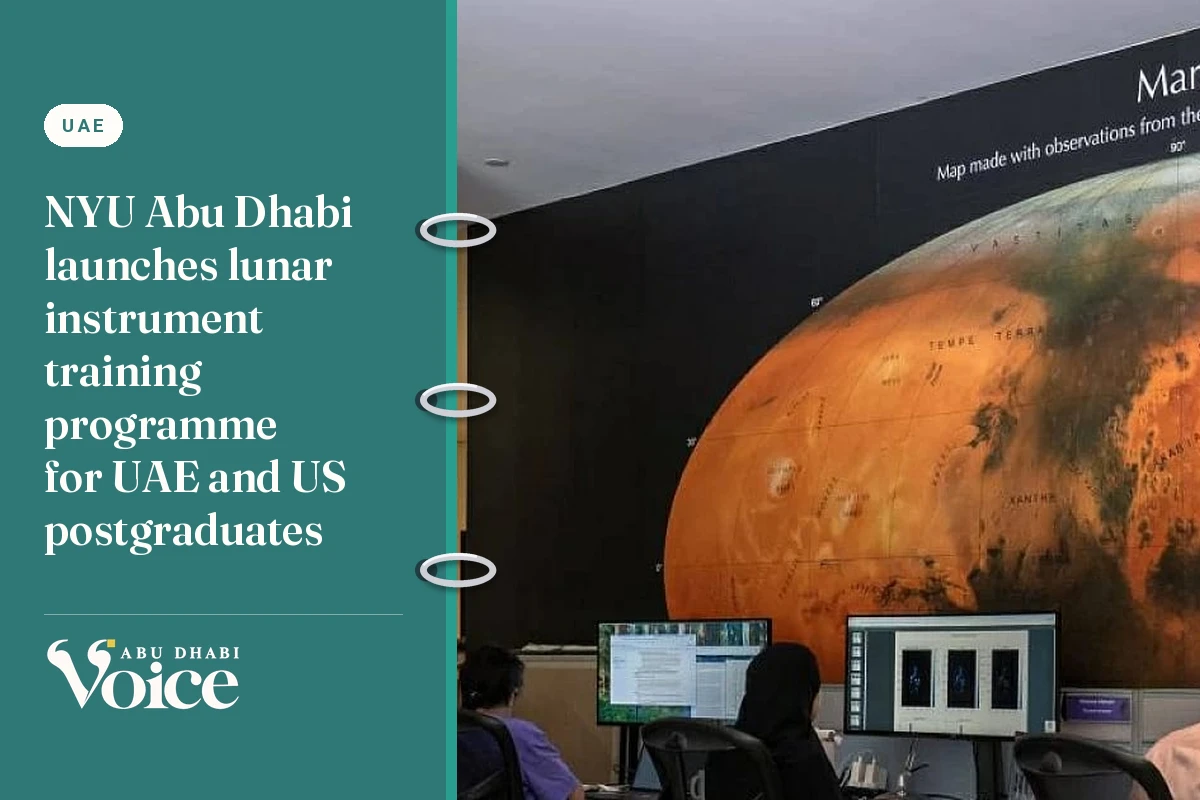
NYU Abu Dhabi launches lunar instrument training programme for UAE and US postgraduates
New York University Abu Dhabi has secured a grant from the US Department of State to run an 18-month initiative that will prepare 30 postgraduate students to create scientific equipment for upcoming Moon missions. The Lunar Exploration Pioneers programme began this month and brings together equal numbers of participants from universities in the United Arab Emirates and the United States.
Mixed teams to design payloads for lunar rover
The cohort will be divided into six integrated teams, each tasked with designing and building a scientific payload intended for a lunar rover under development at NYU Abu Dhabi. Students will guide their instruments from initial concept through to calibrated prototypes, conducting laboratory tests and, where required, trials in simulated space environments.
Read also: UAE and Mozambique leaders advance economic partnership during Abu Dhabi talks
Testing on UAE-made lunar simulant
A two-week residency at the university’s Saadiyat Lunar Lab will allow teams to evaluate their devices on the UAE Lunar Simulant, a material produced from local rocks that replicates key properties of Moon soil. A subsequent characterisation campaign focused on lunar resources is scheduled at the Colorado School of Mines in the United States.
Read also: Louvre Abu Dhabi launches Spices and Wonders exhibition on Indian Ocean trade
Top performers to visit NASA and commercial partner
Teams demonstrating the strongest designs will travel to a NASA centre and a commercial lunar exploration company for further exposure. The programme is directed by Dr Dimitra Atri, principal investigator at the Space Exploration Laboratory within NYU Abu Dhabi’s Center for Astrophysics and Space Science.
“The UAE Lunar Simulant, made from rocks found in the UAE, replicates important characteristics of lunar soil,” Dr Atri said. He added that the university’s Space and Planetary Environment and Analogue Research (SPEAR) facility enables teams to test instruments under space-like conditions. “These facilities provide students with a practical foundation for developing and evaluating instruments through an international, interdisciplinary collaborative effort,” he said.
Deliverables include flight-ready designs and open resources
The initiative aims to deliver six tested instrument sets, with up to three expected to advance to preliminary design review for potential use in future lunar missions or support operations. Participants will also generate calibrated scientific datasets, engineering documentation, and an open-source package of technical challenges for use by future student teams and mission studies.
More in UAE