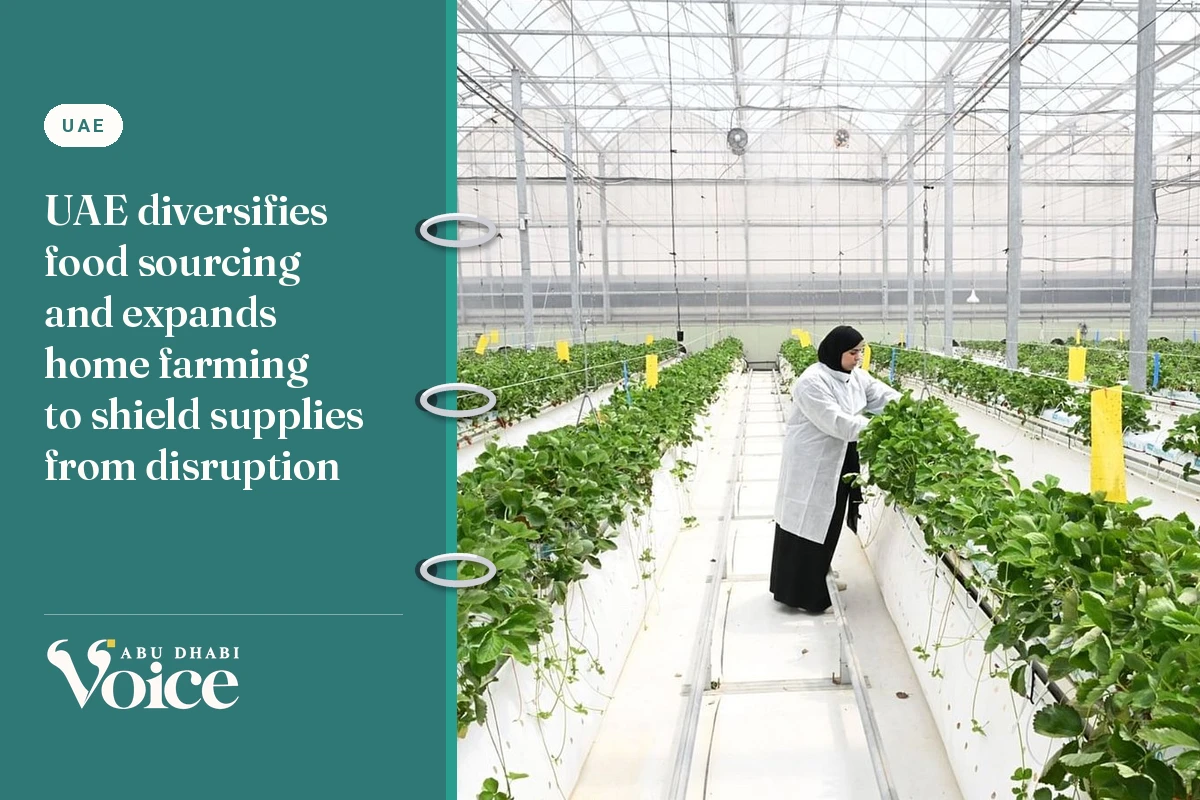
UAE diversifies food sourcing and expands home farming to shield supplies from disruption
The United Arab Emirates is reinforcing its food security system by broadening the range of countries it imports from, increasing domestic agricultural output and building up strategic reserves. The country aims to secure between three and five alternative suppliers for every major food category, a measure designed to keep essential products flowing even when trade routes are interrupted.
These efforts are part of the National Food Security Strategy 2051, a long-term blueprint that coordinates action across production, trade, transport, storage and agricultural inputs to guarantee the continued availability of staple goods.
Diversified supply chains as a core safeguard
The Ministry of Climate Change and Environment told the Emirates News Agency (WAM) that the resilience of a food security system cannot be judged merely by how much is grown locally or what is on shop shelves. Instead, the ministry said, the real test is whether supplies can be maintained under pressure.
The ministry listed several factors it uses to evaluate the country’s readiness: the variety of source countries and suppliers for essential food items, the size of strategic stocks relative to consumption, how swiftly alternative suppliers and shipping routes can be secured, and the efficiency of transport and storage networks. Losses and waste along the supply chain are also taken into account.
Under the National Food Security Strategy 2051, the UAE has drawn up alternative supply plans that cover three to five sources for each major food category. A national programme to cut food loss and waste aims to reduce both by 50 percent by 2030.
The ministry stressed that protecting the flow of food and agricultural supplies must begin well before a crisis hits. This includes identifying priority commodities and the inputs needed to produce them, assessing the risks associated with importing those items, and diversifying the countries of origin, suppliers and transport routes.
The approach is backed by the National Food Security Strategy 2051 and the National Programme to Enhance Supply Chain Resilience, which focuses on mapping essential goods, pinpointing their supply sources and establishing partnerships to keep them available. If a source or route is disrupted, the relevant authorities work with suppliers, logistics partners and private businesses to activate alternatives and reorganise shipments according to the type of goods and market demand.
These measures run alongside efforts to boost domestic farming and ensure the availability of essential inputs such as seeds, fertilisers and animal feed. The ministry said domestic production, import diversification and strategic reserves are complementary parts of the food security system, not separate options.
High‑level United Nations meetings highlight resilience
The UAE underlined its approach to supply chain resilience during the 81st session of the United Nations General Assembly in New York. On September 25, the Ministry of Climate Change and Environment convened a high‑level ministerial meeting and dialogue titled “From Shock to Resilience: Safeguarding Food Security and Essential Supply Chains Amid Regional Disruptions.”
Chaired by Dr Amna bint Abdullah Al Dahak, Minister of Climate Change and Environment, the meeting examined the preparedness of food and water systems and the continuity of essential supply chains. Discussions covered the availability and movement of food products, energy, fertilisers and agricultural inputs through international trade and transport routes. Participants focused on shifting from reacting to disruptions after they occur to identifying risks in advance and building systems that can withstand them.
Dr Al Dahak said that food security requires an approach that encompasses the entire system – from water, energy and agricultural inputs to trade, transport and supply chains. She also highlighted the role of data‑driven planning, diversified supply sources and trade routes, and the partnerships and financing needed to implement food security measures.
Two days earlier, on September 23, the ministry held another high‑level ministerial meeting and implementation dialogue at the UAE Permanent Mission to the United Nations in New York. Titled “From Water Stress to Implementation: Building National Pathways for Water‑Secure Agriculture,” the session was also chaired by Dr Al Dahak.
Discussions focused on water as the foundation for agricultural production, food security, sustainable economic growth and the ability of communities and economies to withstand climate‑related pressures. Dr Al Dahak emphasised the need to move beyond identifying national priorities and to put them into practice, noting that water security is an essential component of national preparedness and sustainable economic growth.
The meeting also showcased the UAE’s experience in efficient water management and its use of advanced technologies, artificial intelligence and climate‑smart agriculture. Other topics included sustainable desalination, vertical farming and smart agricultural practices aimed at protecting natural resources and strengthening food security.
Innovation, technology and long‑term goals
The foundations of the UAE’s current approach were laid with the launch of the National Food Security Strategy 2051 in November 2018. The strategy aims to rank the UAE first globally in the Global Food Security Index by 2051.
It comprises 38 major short‑ and long‑term initiatives. The national food basket identifies 18 essential product categories based on domestic consumption, production and processing capacity, and nutritional requirements. Priorities include diversifying food imports, developing sustainable technology‑enabled domestic production, strengthening research and development, supporting aquaculture, and reducing food loss and waste.
The UAE regards import diversification, domestic production and strategic reserves as interconnected safeguards within its food security framework. Agricultural innovation is another pillar of the strategy, aimed at improving food production while using fewer natural resources.
The country is investing in advanced farming technologies such as controlled‑environment agriculture, vertical farming and hydroponics. Some of these systems can reduce water consumption by up to 90 percent compared with conventional farming, while potentially increasing production and improving crop quality, depending on the technology, crop and operating conditions. These systems support efforts to make domestic food production more resource‑efficient, alongside investment in research, development and innovation across the food and agriculture sectors.
The wider institutional and legislative framework includes the Emirates Food Security Council, which coordinates efforts among relevant authorities, oversees food security priorities, supports supply chain resilience and promotes domestic production. The framework also emphasises international cooperation, diversified trade partnerships and supply sources, and collaboration with international organisations and development institutions.