Masdar City advances net-zero urban model with passive design and clean energy integration
Abu Dhabi’s Masdar City is turning the UAE’s net-zero ambition into a functioning urban district where people already live, work and study. Conceived from the founding vision of the late Sheikh Zayed bin Sultan Al Nahyan and steered today by President Sheikh Mohamed bin Zayed Al Nahyan’s emphasis on sustainability, the development has grown into a mixed-use neighbourhood of offices, laboratories, homes and start-ups.
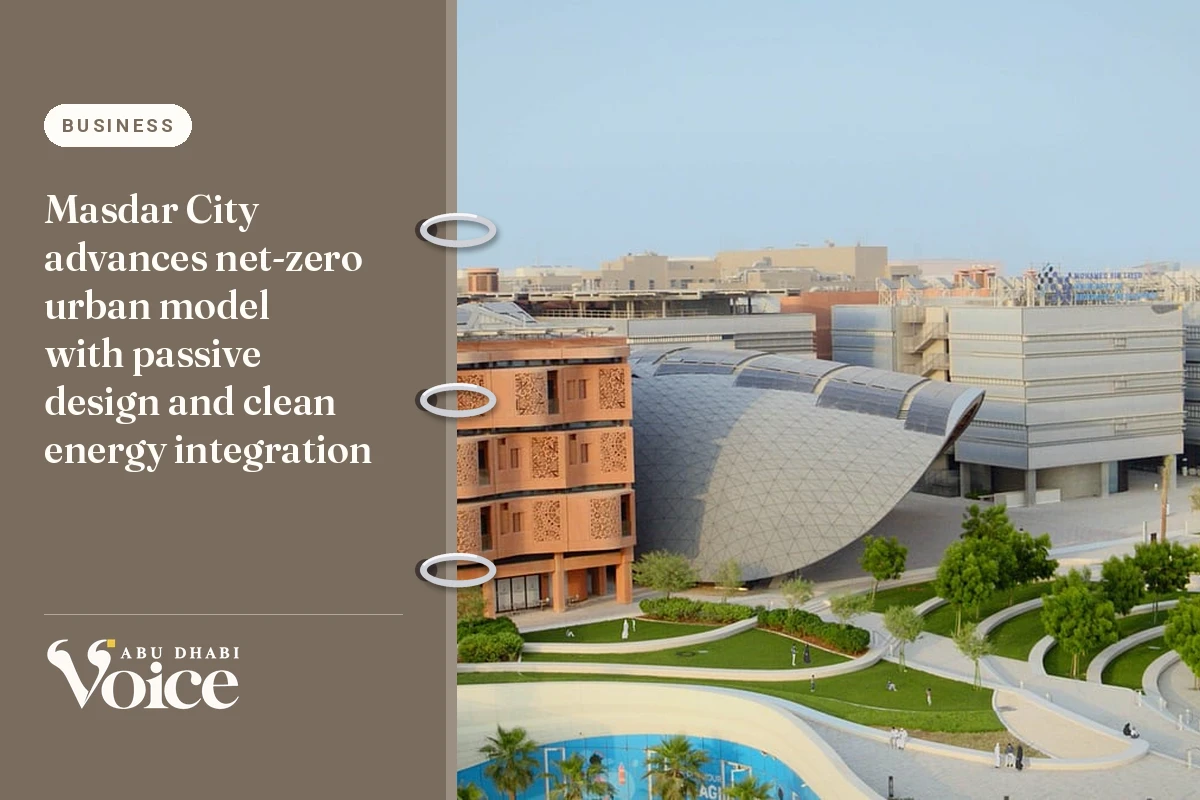
Passive design works with the desert climate
The city’s downtown core rests on a seven-metre podium oriented to capture prevailing winds, creating a microclimate that feels roughly ten degrees Celsius cooler than central Abu Dhabi. Windows are angled and shaded to block harsh sunlight while admitting daylight, and airtight building envelopes with heavy insulation drastically cut air-conditioning demand. Materials follow the same logic: low-carbon concrete for street furniture, recycled aluminium with about one-eighth the embodied carbon of primary metal, certified sustainable timber, and reinforcing steel made from scrap. An on-site facility recycles steel, concrete and timber, keeping construction waste out of landfill. More than 11 megawatts of solar panels are woven into the city fabric rather than added as an afterthought.
Read also: Abu Dhabi Police roll out month-long drive to shield families from drugs and cyber threats
From energy company to global clean-power platform
The name Masdar extends well beyond the city limits. The Abu Dhabi Future Energy Company, known as Masdar, was created by the UAE government in 2006 to leverage the country’s energy leadership and diversify its economy. Under founding chief executive and current chairman Dr Sultan Ahmed Al Jaber, the company has notched several firsts, including Shams 1, the Middle East’s first concentrated solar plant, and the London Array, one of the world’s largest offshore wind farms. Its platforms — the annual Abu Dhabi Sustainability Week and the Zayed Sustainability Prize — have recognised 96 winners whose work has improved life for more than 370 million people globally.
Read also: LifeBot launches medical command network at Abu Dhabi military medicine congress
A new ownership structure took shape in December 2021 when TAQA and ADNOC joined Mubadala as shareholders, formalised in December 2022. The combination merges TAQA, Mubadala and Masdar’s renewable expertise with ADNOC’s hydrogen, infrastructure, trading and logistics capabilities, forming a clean-energy powerhouse aimed at spearheading the UAE’s Net Zero by 2050 strategy and expanding the green hydrogen economy. Today Masdar operates across utility-scale and distributed solar, onshore and offshore wind, geothermal, storage, green hydrogen and emerging clean technologies, with a portfolio exceeding 65 gigawatts in more than 20 countries and a 2030 target of 100 gigawatts backed by roughly USD 30–35 billion in planned equity and project finance.
Read also: Abu Dhabi’s 13 Halloween haunts: teen brunches, spooky villages and late-night circus
Living laboratory for net-zero buildings
Masdar City, a subsidiary of Mubadala Investment Company, sits at the centre of the UAE’s push to become the first MENA nation to commit to net zero by 2050, a pledge made in 2021. The city’s 2024 environmental, social and governance report quantifies progress: energy consumption dropped 31 percent, 98.3 percent of construction waste was diverted from landfill, Emiratisation reached 54.7 percent, women comprised 31 percent of the workforce, and more than 300 community events drew residents and businesses together. Tenants now span artificial intelligence, life sciences, energy, space technology, agri-tech and mobility, including women-led enterprises.
The most striking chapter is still unfolding. Masdar City Square, a cluster of seven commercial buildings totalling 50,000 square metres, targets LEED Platinum, WELL Gold and Estidama 4 Pearl ratings. Its centrepiece, the corporate headquarters, is on track to become Abu Dhabi’s first net-zero energy building of its kind. A south-facing canopy of 1,033 solar panels tilted at 22 degrees shades the structure while generating power, cutting energy use 102 percent against international baselines and producing 109 percent of annual needs, with Zero Energy certification from the International Living Future Institute in sight. Nearby, The Link adds five commercial and residential buildings covering 30,000 square metres. Both projects were listed with a 2025 target completion on the city’s project pages.
Mobility experiments and climate-tech engine
Transport accounts for roughly 15 percent of global carbon emissions, and Masdar City has used its streets to pilot two generations of mobility systems, with a third in development, built on the premise that future transport will be shared, electric and autonomous. The Smart and Autonomous Vehicle Industries cluster hosted in the city aims to shape smart mobility across air, land and sea. Beyond infrastructure, Masdar City partners in the Innovate for Climate Tech platform alongside Tencent and Catalyst with support from COP28, linking start-ups, investors and corporates to bring the Global South into the climate-technology conversation. Companies of every scale, from early-stage ventures to multinationals, are developing practical solutions on site.
More in Business