Bridal treasures from Ottoman and Anatolian traditions open in Abu Dhabi exhibition
An exhibition tracing a millennium of wedding customs from Anatolia and the Ottoman Empire has opened in Abu Dhabi, displaying intricately embroidered garments, bridal accessories and household items that have been passed down through generations.
‘Bridal Treasures: A Journey Through Ottoman and Anatolian Treasures’ launched on Tuesday at Manarat Al Saadiyat under the patronage of Emine Erdoğan, First Lady of Türkiye, in partnership with the Department of Culture and Tourism Abu Dhabi.
Stories stitched into cloth
Speaking at the opening reception, Abdullah Eren, President of the Turkish Cooperation and Coordination Agency (TİKA), invited attendees to picture the moment a bridal chest is lifted open. “In Anatolia, when a bridal chest is opened, every object inside has a story to tell, each piece holds a mother’s care in its cloth and a young woman’s hopes in its embroidery,” he said. He paid tribute to women who “have made an invaluable contribution to the growth and continuum of our culture and still is today.”
Noora Al Kaabi, Minister of State at the UAE Ministry of Foreign Affairs, spoke on behalf of Abu Dhabi. “At its heart, this exhibition is about transmission: what one generation chooses to preserve and what it places in the hands of the next,” she said. She noted that the Turkish word for trousseau, çeyiz, comes from the Arabic jihaz, “a reminder of the bond between two cultures. In the UAE’s Year of the Family, the family is where heritage first becomes personal.”
Turkish Minister of National Education Yusuf Tekin said the objects speak about people everywhere. “The difference is our richness,” he said, calling family a value that Türkiye and the UAE share. Showing the exhibition in the Emirates, he added, would “provide solidarity and friendship” between the two nations.
Gallery of bridal heritage
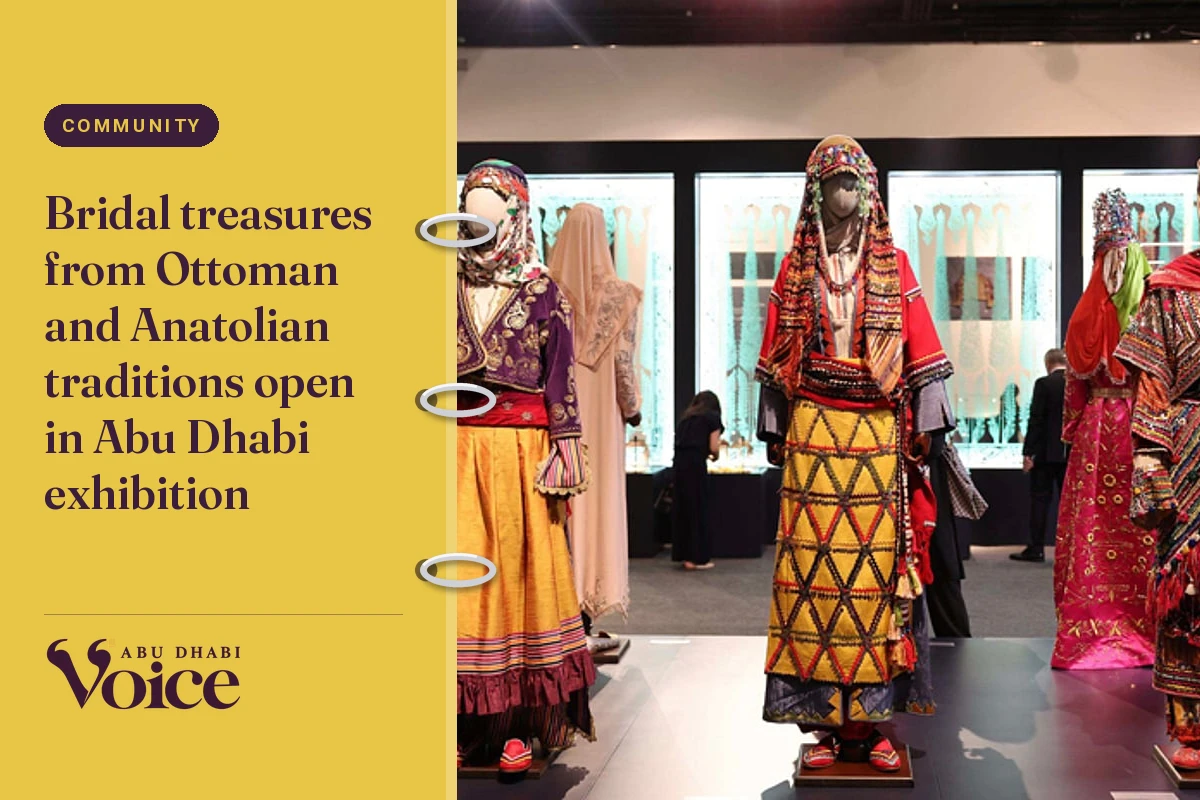
Visitors move from a bright entrance into a dimly lit hall where spotlights fall on wedding garments, bridal accessories, embroidered coverings, woven cloth, carved woodwork and household pieces. The display illustrates how women’s craftsmanship preserved traditions across generations. The exhibition was designed by TEATI Architects, an Ankara-based studio specialising in exhibition design.
In the hall, brides from various parts of Anatolia appear beneath black arches in pink, scarlet, green and cream, their metallic embroidery catching the light. Above the foremost bride, a canopy of white floral garlands descends from a frame of light, as if she were standing under a blossoming tree.
Alongside the bridal displays are objects related to the coffee ceremony, the Turkish bath and daily devotion. In a recreated Ottoman salon, faded blue-and-gold walls rise behind crystal candelabra and an ornate carved mirror, with red damask chairs on a rose-and-cream rug. At the centre stands a bride in a red veil, her gown scattered with gold. Nearby texts recall the splendour of imperial weddings, including festivities in 1582 that lasted fifty-two days and nights.
Wall panels in Turkish, Arabic and English follow the trousseau from the Seljuk period to the Ottoman court and focus on the bridal hammam and the ritual of Turkish coffee. One panel captures the mood: “Every drop shed upon the göbek taşı (Navel stone of the hamam) carries a woman’s hope for her new life.”
The exhibition runs until October 26 at Manarat Al Saadiyat – Gallery S in Abu Dhabi and is open to all visitors.