From garden play to global stage: Ghaya’s journey as a young environmental advocate
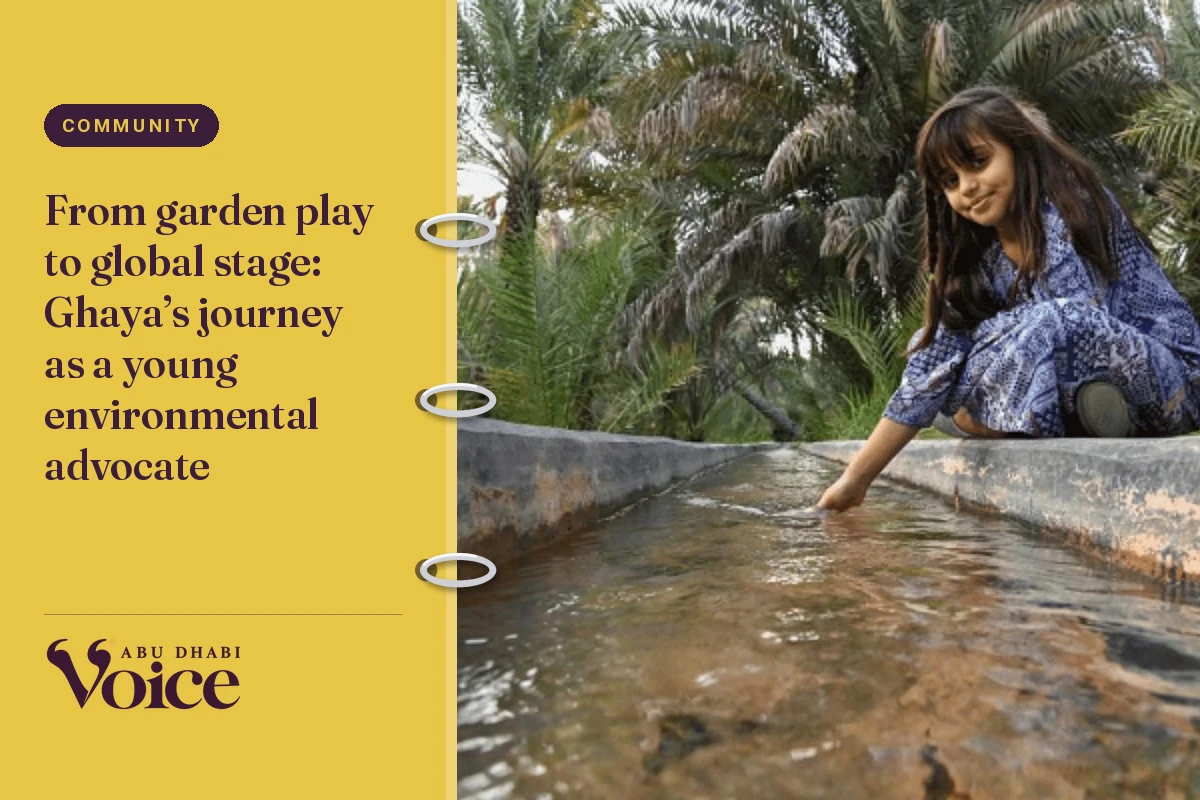
Maryam Al-Aryani often spent afternoons in the garden with a cup of coffee or tea, quietly observing her children at play. Those moments, she said, revealed their true personalities as they interacted freely without awareness of being watched or judged. Her six children included Ghaya, who today is known as “Green Ghaya” and became the youngest UNICEF Youth Advocate to address the COP28 climate conference.
A bond with nature rooted in family life
Ghaya’s closeness to the natural world did not stem from a formal environmental project but from everyday family experiences, her mother explained. Trips to the family farm and outings into the desert with her father were not considered educational activities but shared memories. During summers, her father made a deliberate effort to put out water for birds, and Ghaya helped him. This made nature a lived reality rather than something she encountered only in books.
Building a community of young environmentalists
Maryam provided all her children with diverse experiences—cooking, drawing, crafts, reading, sports and technology—without expecting any of them to settle on a future path. “I wanted them to build a broad base of experiences that would allow them to discover for themselves: ‘This feels like me. This does not’,” she said. Ghaya’s curiosity about nature and animals grew into questions about protecting the environment, leading her to involve others and eventually found the Green Buds community, a group where young people work toward a sustainable environment and development.
Her siblings also developed their own interests at different paces. Naila gravitated toward stories, writing, photography and presenting. Hamad discovered a passion for technology, coding, artificial intelligence and sports. Maryam described her role as staying “close enough to guide them, but far enough back for them to feel that the experience belongs to them.” As a working mother, she could not do everything for six children, so each learned to manage on their own. “When I tell my child, ‘This is your responsibility,’ I am not simply giving them a task, I am also sending them a message: ‘I trust that you can do this’,” she said.
Friends and relatives often remarked that her children seemed older than their years. Maryam attributed this to speaking with them seriously and respectfully. She believes self‑confidence is not built through repeated praise but by giving children real chances to try, allowing them to make mistakes and try again, and letting them discover their own abilities. A child whose voice is heard at home carries that confidence outside. “When a child discovers that their voice is heard inside their own home, they become more confident using that voice outside it too,” she said.
Family traditions and intergenerational values
Bedtime was not just for sleeping but for storytelling, talking, asking questions and imagining. Costumes and role‑playing let the children try on different identities and professions. “I loved the idea that their childhood could be a wide‑open space for imagination before the world began telling them what they should become,” Maryam said. The children’s grandparents lived with the family and became a central part of daily life, giving them stronger language skills, conversation abilities, a sense of belonging, respect for older generations and lasting family memories.
Not every activity led to success. Maryam said a child might try something and dislike it, or lose a competition they had prepared for. At home the first question is not why they did not win but “What did you learn? What would you do differently next time? Would you like to try again?” A child’s place in the family never depends on the answer. “Our love and pride in them do not change because of a ranking, a prize or a result. I want my children to understand that failure is not the opposite of success. Sometimes it is part of the journey towards it,” she said.
Behind her approach are values of respect, generosity, humility, giving, responsibility and strong family bonds—principles she learned from her own parents and grandparents and traces to the legacy of Sheikh Zayed bin Sultan Al Nahyan. “They were a way of life,” she said. She wants her children to embrace technology and the future without losing touch with their roots. Her responsibility, she said, is not only to raise successful children but to protect a chain of values.
Her advice to other parents is simple: do not rush to identify a talent. Take children to the library, the desert, the farm, the museum. Let them spend time with animals and nature. Let them read, build things, take things apart. “Then watch. Sometimes children tell us who they are without saying a single word, simply through the things they keep returning to when we give them the freedom to choose.”