ICU-level care becomes lifeline as airspace closures challenge Gulf medical evacuations
Airspace restrictions, airport shutdowns and unscheduled flight reroutes across the Gulf region are turning medical evacuations into complex operations that require intensive-care standards from the moment a patient leaves the referring hospital until they reach the receiving facility, experts warn.
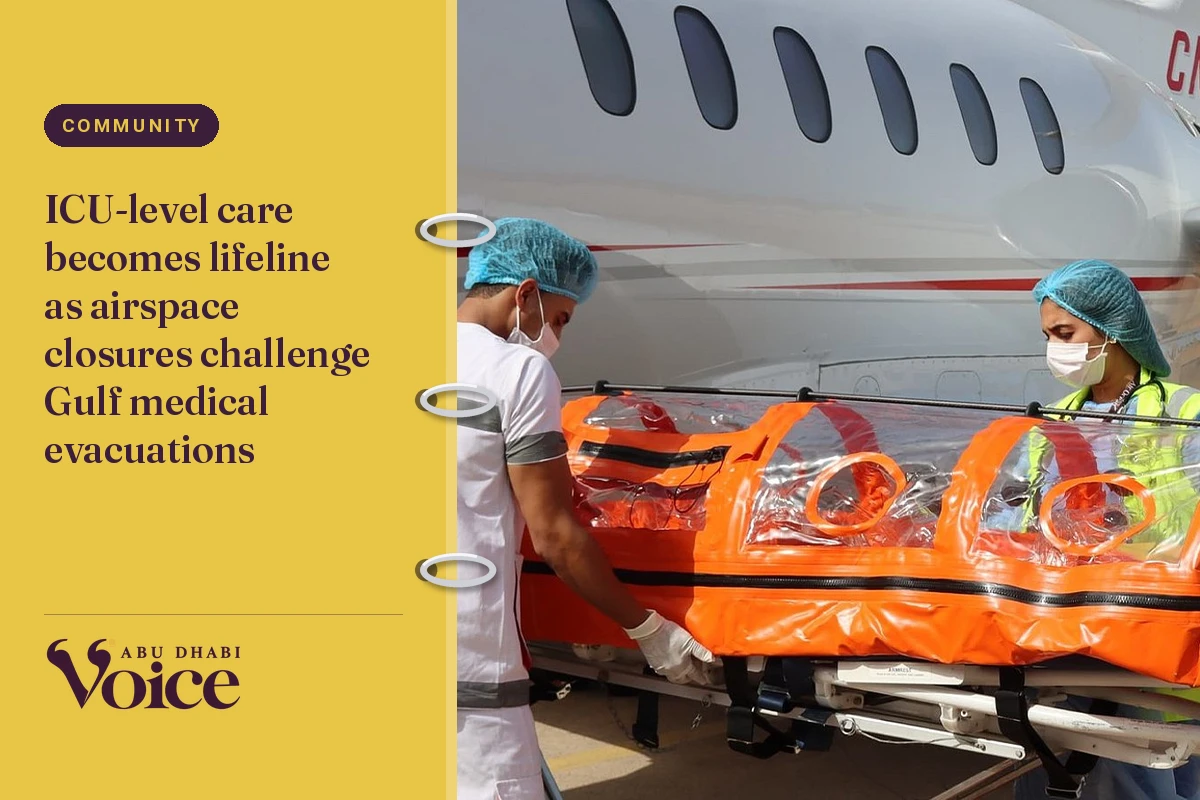
For critically ill patients, any extension of travel time can directly affect oxygen supply, medication timings, monitoring capabilities and access to appropriate medical facilities. Medical teams must assess not only whether a patient is fit to fly but also whether treatment can be sustained if the route changes unexpectedly during the mission.
Planning for the unexpected
Satish Munoli, Chief Executive Officer of ICATT RESPONSE PLUS, said that complex medical evacuations demand far more than aviation know-how. They require the ability to analyse multiple scenarios, anticipate possible failures and develop contingency plans for each of those scenarios well before take-off.
“In times of regional disruption, continuity of clinical care and seamless multi-layered stakeholder coordination become mission-critical,” Munoli said.
Decisions often have to be made dynamically as clinical, aviation and logistical conditions evolve. Achieving continuity of ICU care from the referring hospital, through ground and air transport, to the receiving facility requires rigorous planning, precise execution and, above all, the judgement that comes from extensive experience in complex operating environments.
Maintaining continuity of care
A medical transfer involves multiple stages: stabilising the patient at the referring hospital, orchestrating end-to-end logistics management of the medical crew and equipment, planning aviation routing, obtaining airspace permits, coordinating with multiple countries and authorities, preparing precise international documentation, readying the aircraft, performing safety checks, liaising with ground ambulance teams, airport security, ground handlers, air traffic control and fuelling services, managing patient loading systems, monitoring the patient on the ground and in flight, handling family expectations and the comfort of accompanying attendants, and finally handing over care to the receiving medical team.
Each transition can introduce risks, particularly for patients dependent on ventilators, critical-care medications, advanced interventions such as ECMO, infusion pumps or other monitoring equipment like arterial blood gas analysers and arterial lines. Route changes add further complexity, forcing teams to reassess the patient’s clinical needs alongside fuel requirements, aviation permissions, alternative airports, ambulance arrangements, additional medications, oxygen supplies and blood products.
“The ICU should effectively travel with the patient,” Munoli said. “The safest evacuation is not necessarily the one that follows the shortest route, but the one that preserves continuity of care, anticipates possible disruptions and ensures every team is prepared to respond if circumstances change.”
Preparedness beyond the hospital
Medical evacuation depends on coordination among clinicians, aviation crews, ambulance providers and hospitals. When conditions change, decisions must balance the patient’s clinical status with aircraft capabilities, logistical limitations, crew duty-hour management and the availability of suitable backup receiving facilities along the flight path.
Communication technology, information-sharing, clinical expertise and operational experience all come together to support highly complex medical evacuations. Advanced planning tools, real-time information and data-driven decision-making strengthen the ability to analyse multiple scenarios, anticipate potential challenges and build robust mission plans. Technology enhances this capability, but the real differentiator is the judgement of highly experienced teams who know how to interpret information and make the right decisions in demanding clinical and operational environments.
At ICATT RESPONSE PLUS, technology, clinical expertise and operational experience combine to support these missions.
The wider healthcare agenda in Abu Dhabi increasingly emphasises anticipation and resilience. Future Health – A Global Initiative by Abu Dhabi has selected “To Sense Is to Predict” as its 2026 theme, highlighting the role of early insights and intelligent technologies in more proactive healthcare. This provides broader context for the sector, without implying any direct affiliation between the initiative and ICATT RESPONSE PLUS.
Clinical judgement remains central
Even with careful planning and advanced equipment, trained medical professionals remain essential to assessing a patient’s condition and responding to changes during transfer. Coordination must continue until the receiving clinician formally accepts responsibility for care. Patient safety does not begin at take-off or end at landing. It starts with the referring team’s assessment and continues until the receiving clinician accepts care. In uncertain conditions, preparedness is part of the clinical response.
As healthcare systems across the region strengthen emergency preparedness, connecting clinical expertise, aviation capabilities and coordinated hospital handovers remains essential to protecting patients beyond the hospital walls.