Louvre Abu Dhabi: A living museum where art, light and quiet meet
A personal encounter
Ahmed Jamal Omar Alyafai, a 23‑year‑old motorcycle enthusiast who does not consider himself a museum person, visits Louvre Abu Dhabi roughly once a year because the displays never remain the same. On one occasion he intended to sit for just five minutes on a bench in a quiet room, but ended up staying for 25 minutes, studying a single canvas and feeling as though he was seeing it through the painter’s eyes.
He recalled, “I wanted to sit for five minutes. I ended up sitting there for a good 25 minutes, just looking at the same painting,” he says. “I felt like I was experiencing what the painter was experiencing while he was doing it.”
Ahmed first came to the museum as a 15‑year‑old in 2018 or 2019 and has returned about five times since. He describes himself as more of an outdoorsy person: “I am more of an outdoorsy person: motorcycles, bikes, racing.” What draws him back is the quiet: “Sometimes I just need some quiet, and that place generally gave me the peace I was looking for.”
On his most recent visit he was showing a friend around for the first time. After hours on his feet he found a lone bench in a nearly empty room, with a few large paintings that passing visitors were ignoring. He noted that large tour groups are constant yet “they always manage it perfectly,” he said, so those seeking calm are rarely disturbed.
Origins and vision
The museum exists because France and the United Arab Emirates signed an intergovernmental agreement on 6 March 2007, agreeing to create the Arab world’s first universal museum. Under that deal the Louvre name travelled south, bringing works from every part of the globe chosen for their historic, cultural and sociological interest, ranging from ancient artefacts to contemporary pieces.
Making the project a reality required a coalition of 13 French public institutions united under Agence France‑Muséums, including the Louvre itself, the Centre Pompidou, the Palace of Versailles, the Musée d’Orsay, the Musée Rodin and the Bibliothèque Nationale de France.
The site chosen was Saadiyat Island, described as a virgin lagoon between sand and sea, between shade and light. Architect Jean Nouvel, a Pritzker Prize winner, said he took his cue from the island rather than from any museum he had previously seen.
Inside the galleries
Inside, the galleries do not organise works by country; instead they follow chronological themes and place civilisations side by side that may at first glance seem unrelated. The museum’s own holdings comprise some 700 artworks and groups of artworks covering prehistory to the present day. In addition, about 300 works are on loan from French partners, and the Louvre in Paris sends 100 different masterpieces each year, keeping the collection in constant flux.
Ahmed observed, “It is not the same art every time you go,” The 23‑year‑old said, who first came as a 15‑year‑old in 2018 or 2019 and has returned about five times since.
He also highlighted the Islamic manuscripts and works drawn from collections worldwide, including pieces from the Louvre in Paris, and noted that some galleries are built around a single artefact, giving each space the feeling of a distinct era.
The dome and its light
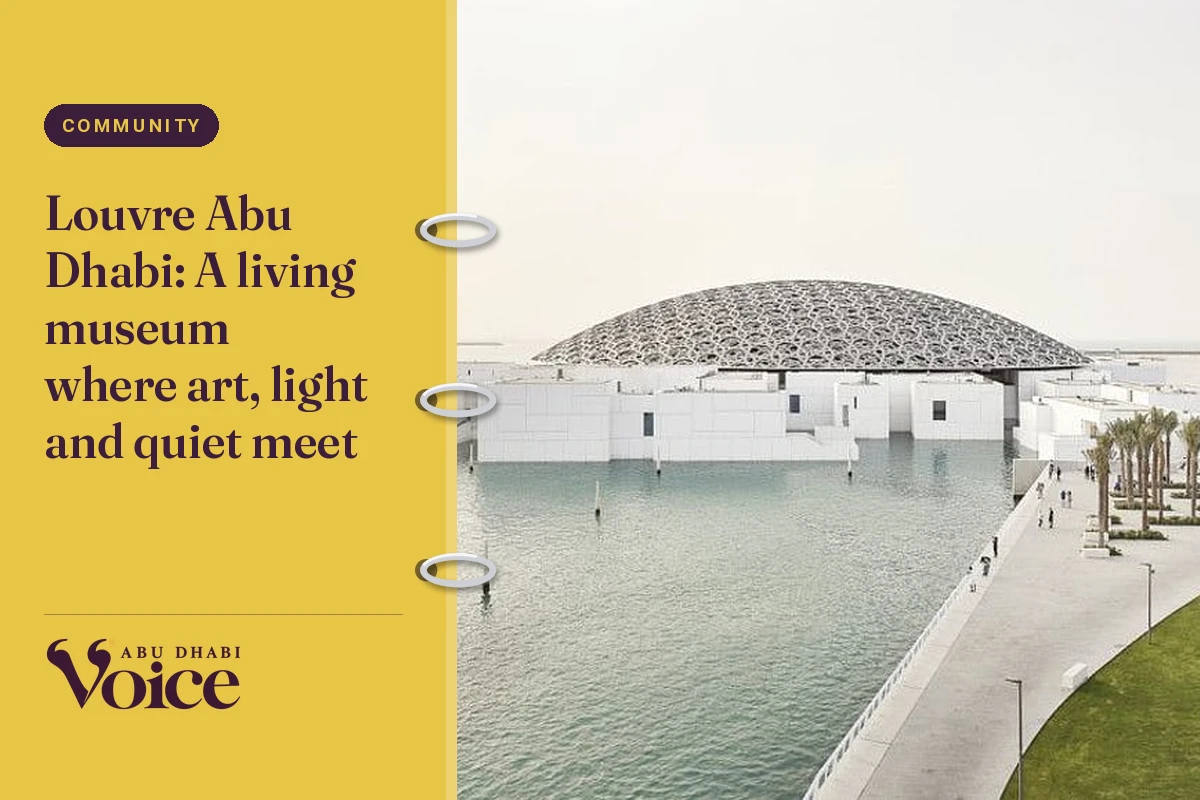
From a distance the museum’s dome appears to float—a large silvery disc hovering above the museum‑city and the first sight for visitors arriving by land or by sea. Beneath it the light does not pour in; it falls in fragments.
The dome is a geometric structure of 7,850 stars, repeated at various sizes and angles across eight layers. Four outer layers are clad in stainless steel and four inner layers in aluminium, separated by a steel frame five metres high. A ray of sunlight must pass through every layer before it becomes visible and then disappears again, producing a shifting scatter of light on the white walls and the water below that Jean Nouvel himself calls a “rain of light.”
The dome spans 180 metres in diameter, rests on just four piers each 110 metres apart, and rises 36 metres above ground level. Its form was inspired by the cupola, a hallmark of Arabic architecture, and its pattern pays tribute to the palm trees of Abu Dhabi. Practically, the dome shades the buildings beneath it and, as Nouvel has said, creates a microclimate.