UAE skywatchers set for Orionid meteor shower peak on Wednesday night
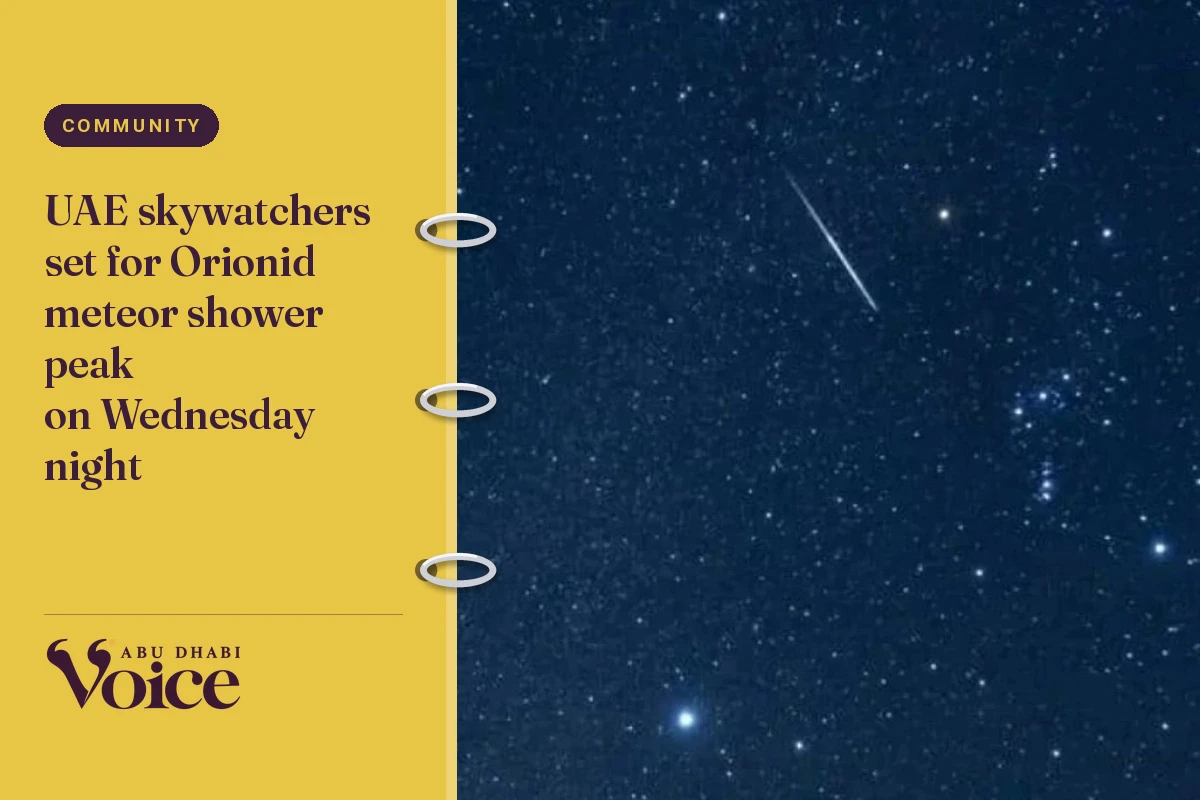
Residents across the Emirates can look forward to witnessing up to 20 meteors per hour on Wednesday night, when the annual Orionid meteor shower reaches its highest activity. The display, caused by fragments of Halley’s Comet entering Earth’s atmosphere, is expected to produce bright streaks across the autumn sky.
Peak viewing window
The celestial show is forecast to peak overnight from Wednesday, 21 October, into Thursday, 22 October, as the planet travels through a dense cloud of dust and debris left by the famous comet. Ibrahim Al Jarwan, Chairman of the Board of Directors of the Emirates Astronomical Society and a member of the Arab Union for Astronomy and Space Sciences, said that under ideal conditions observers could see between 10 and 20 meteors every hour, with the best opportunities coming between midnight and dawn.
How the Orionids work
The Orionids occur when tiny particles shed by Halley’s Comet burn up in the atmosphere at altitudes of roughly 80 to 120 kilometres, creating bright light trails that typically last just a few seconds. According to NASA, these meteors are among the fastest linked to any annual shower, travelling at about 66 kilometres per second. Some leave luminous trails that linger briefly after the meteor itself fades.
The meteors appear to radiate from a point near the constellation Orion, which rises into view in the south-eastern sky during the early hours of Thursday. Despite this apparent origin, the shooting stars can appear anywhere across the sky, so a wide, unobstructed view is recommended.
Moonlight may reduce visibility
This year’s display faces a challenge from a bright waxing gibbous Moon, which is likely to outshine many of the fainter meteors for much of the night. Al Jarwan noted that viewing conditions should improve once the Moon sets after midnight, leaving a limited period of darker skies before sunrise. In Dubai, the Moon is expected to set at approximately 2:26 am on Thursday, 22 October, making the hours immediately afterwards particularly favourable for meteor watching, provided skies remain clear.
Tips for the best experience
Al Jarwan advised observers to allow their eyes enough time to adjust to the darkness. While some adaptation begins after five to 10 minutes, it generally takes 20 to 30 minutes to develop significantly better night vision. For the best experience, stargazers should seek locations away from city lights and avoid looking at brightly lit mobile phone screens while observing. No telescope or binoculars are needed; the meteor shower can be enjoyed with the naked eye.
The Orionids are active from 2 October to 7 November this year, although the greatest concentration of meteors is expected around the peak on 21 and 22 October.