Gulf and European security intertwined, FNC speaker urges binding partnership
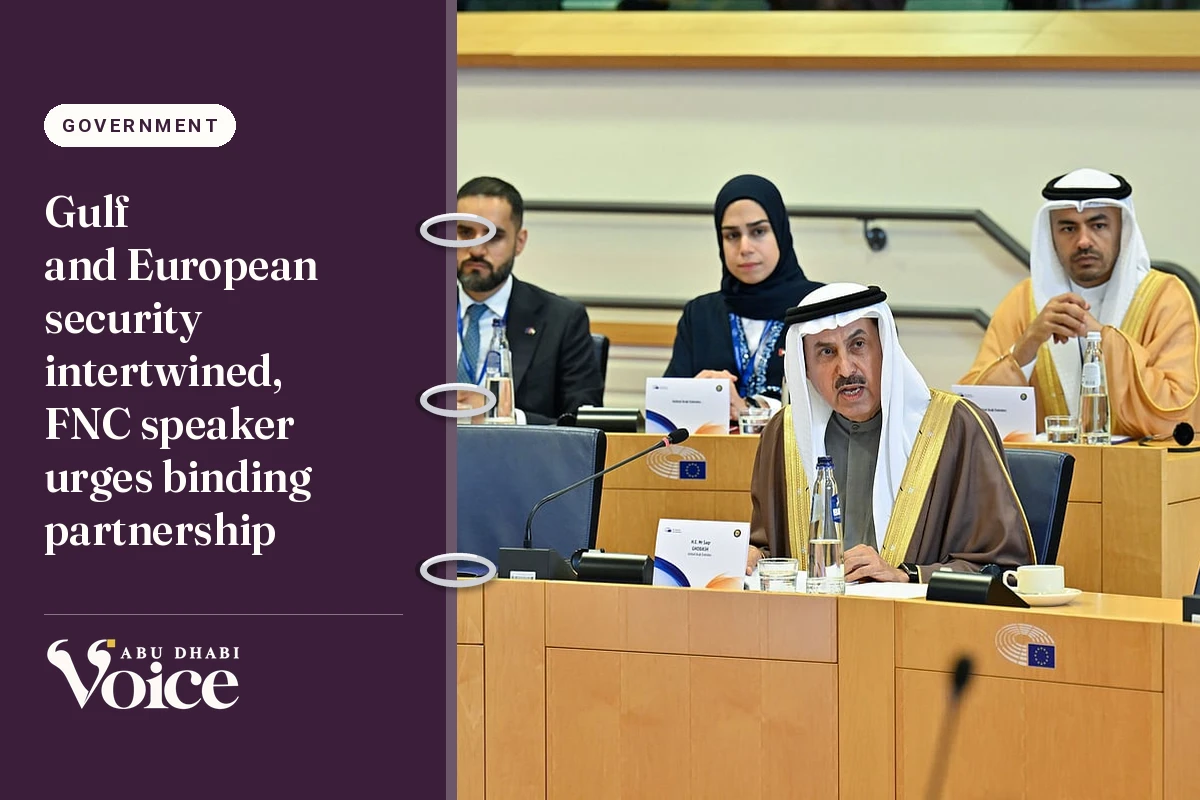
FNC Speaker Saqr Ghobash and European Parliament President Roberta Metsola affirmed that Gulf and European security are now inseparable, urging a strategic partnership built on mutual commitments, regular dialogue and joint action to tackle shared threats.
Security Interdependence
Ghobash told the gathering in Brussels that the Gulf cannot view its security as separate from Europe’s, stressing that any partnership must rest on clear, reciprocal obligations, sustained consultation and long‑term cooperation able to survive crises. He said each side’s security and legitimate interests must be reflected in the other’s positions and policies.
He noted that the meeting, held on a Friday at the European Parliament’s headquarters, brought together Metsola, GCC Secretary‑General Jasem Mohamed Albudaiwi and other officials, and that he thanked Metsola for her warm welcome and praised the organisers for arranging the session.
Ghobash highlighted Metsola’s condemnation of Iranian attacks against the UAE and her show of solidarity during a call with President Sheikh Mohamed bin Zayed Al Nahyan, saying her stance honoured the UAE’s sovereignty and illustrated what partnership means when a partner’s security is under threat.
He reaffirmed the UAE’s commitment, under the leadership of President Sheikh Mohamed bin Zayed Al Nahyan, to deepening ties with Europe on the basis of mutual interests, security and development.
Framework for Parliamentary Cooperation
Ghobash called for an institutionalised structure for GCC‑European parliamentary dialogue, proposing permanent channels between committees covering security, energy, the economy, technology and climate to produce concrete legislation and policies that benefit citizens on both sides.
He welcomed the European Parliament’s move to draft a strategy aimed at countering the infiltration of extremist Islamist networks, especially those linked to the Muslim Brotherhood, describing it as an effort to protect societies, institutions and the broader security, coexistence and stability of the region.
He pointed out that the meeting built on the understandings reached in Abu Dhabi in June 2025 to strengthen the GCC‑EU strategic partnership and to hold annual gatherings, adding that current regional and international developments require both sides to move beyond debating the partnership’s value and to spell out the reciprocal duties it entails.
Ghobash stressed that Gulf security sits at the core of the partnership with Europe, citing the joint condemnation by GCC and EU foreign ministers on 5th March 2026 of Iranian attacks against GCC states, which they labelled a threat to regional and international security.
He recalled that GCC states had repeatedly stated they would not let their territories be used as launchpads for attacks against Iran, yet they had suffered direct Iranian strikes and assaults by Iran‑backed militias targeting their facilities and endangering civilians.
He said the violence had reached the Barakah Nuclear Energy Plant, raising worries that extended beyond national borders to nuclear, environmental and human security.
Ghobash expressed the UAE’s solidarity with Saudi Arabia, other GCC members and Jordan, and denounced the recent Houthi strikes on King Khalid Airport and Riyadh Airport in Saudi Arabia as an escalation that breaches international law and norms.
He urged an end to the financing, arming and backing of armed groups, rejecting any ideological or political excuse that undermines state sovereignty or threatens public safety.
He reiterated the UAE’s wish for stable relations with Iran grounded in good neighbourliness, respect for sovereignty and non‑interference in internal affairs.
Ghobash added that any serious diplomatic effort must tackle the root causes of the attacks, while any settlement must rest on clear, verifiable Iranian pledges to prevent a recurrence, irrespective of the attack’s origin or form.
He emphasised that Gulf states must be indispensable partners in any arrangement affecting their security, as they are the parties most directly concerned and best placed to identify their own needs, ensuring that such agreements are realistic and sustainable.
Ghobash acknowledged Europe’s close ties with the United States and the priorities flowing from global crises, but argued that Europe’s own stakes in the Gulf make continued GCC‑European cooperation essential in its own right, regardless of whether transatlantic positions converge or diverge.
He said recent events have shown that Gulf and European security can no longer be treated as separate matters, warning that any disruption in the Strait of Hormuz or a threat to the Bab al‑Mandab Strait would reverberate through energy markets, trade routes and supply chains across Europe and the wider world.
Ghobash noted the Gulf states’ ongoing contributions to ending the war in Ukraine, including humanitarian aid and facilitation of prisoner exchanges, and suggested these efforts open space for broader consultation on crises that affect the security and interests of both regions.
He urged the European Parliament to help cultivate a comprehensive understanding of the GCC‑EU partnership through dialogue with EU institutions and member‑state governments, covering economic, security, political and other cooperative fields.
The UAE, he said, stands ready to engage with European priorities with the same seriousness it expects Europe to show toward Gulf concerns.
Observing that the meeting preceded the second GCC‑EU Summit slated for Saudi Arabia, Ghobash expressed hope that the parliamentary exchange would feed into the summit’s agenda and support the implementation of leaders’ accords.
He closed by thanking Metsola for her hospitality and reaffirming the necessity of ongoing parliamentary dialogue and coordination to advance the GCC‑EU strategic partnership and to foster security, stability and development regionally and internationally.
European Parliament’s Perspective
For her part, European Parliament President Roberta Metsola reiterated the importance of bolstering the EU‑GCC strategic partnership and expanding parliamentary, security and economic cooperation to promote regional and international stability, trade, investment and closer people‑to‑people ties.
In her opening remarks she recalled that the parliamentary dialogue was launched in Abu Dhabi in June 2025 at the invitation of the UAE and the FNC Speaker, Saqr Ghobash.
She welcomed the attendees, including the European Parliament members tasked with relations with the Arabian Peninsula and foreign affairs, and stressed the need for sustained dialogue and engagement.
Metsola expressed solidarity with those affected by the attack on King Khalid International Airport in Riyadh and condemned the incident on behalf of the European Parliament, saying her thoughts were with the victims, their families and all others impacted.
She said rising international and regional uncertainty demands stronger cooperation and tighter connections between peoples, pointing to the fallout from Russia’s war in Ukraine and to what she described as persistent attacks by Iran and its proxies in the Gulf, which cause casualties, damage to critical infrastructure and wider security repercussions.
Metsola stressed the growing significance of diplomacy, recognising the role of the GCC states and the GCC Secretary‑General in supporting peace initiatives, dialogue and mediation aimed at global stability.
She said parliamentarians bear an important responsibility to uphold these efforts by keeping communication channels open.
She referred to the European Parliament’s response to developments in the Middle East and its work concerning the inclusion of Iran’s Islamic Revolutionary Guard Corps on the EU list of terrorist organisations.
On maritime security, Metsola highlighted Europe’s continued support for protecting trade routes through Operations ASPIDES and ATALANTA, urging stronger cooperation to shield shipping lanes in the Red Sea and the Strait of Hormuz, to safeguard people and to keep economies running without interruption.
Turning to economic relations, she urged the GCC and EU to shift from a mere focus on stability toward greater growth and prosperity through a partnership that backs businesses, opens new markets and deepens trade and investment.
She noted that bilateral trade in services had more than doubled over the past ten years, illustrating the potential for richer economic ties, and called for a new trade agreement to advance cooperation.
Metsola also advocated expanding cooperation in education, scientific research, culture, technology and energy, alongside stronger energy connectivity, infrastructure development and coordination on digital transformation to boost shared resilience.
She emphasised the need for ongoing dialogue on human rights and joint action against extremism and terrorism, saying the strategic partnership can bring the two regions nearer and deliver concrete benefits to their populations.
Metsola identified visa‑free travel arrangements as a key priority for Gulf citizens and said the meeting offers a chance to turn shared ambitions into practical steps that move the partnership forward.
She concluded by urging both sides to build on the current momentum, deepen parliamentary cooperation in the months and years ahead, and strengthen people‑to‑people ties in the pursuit of stability, growth and shared prosperity.