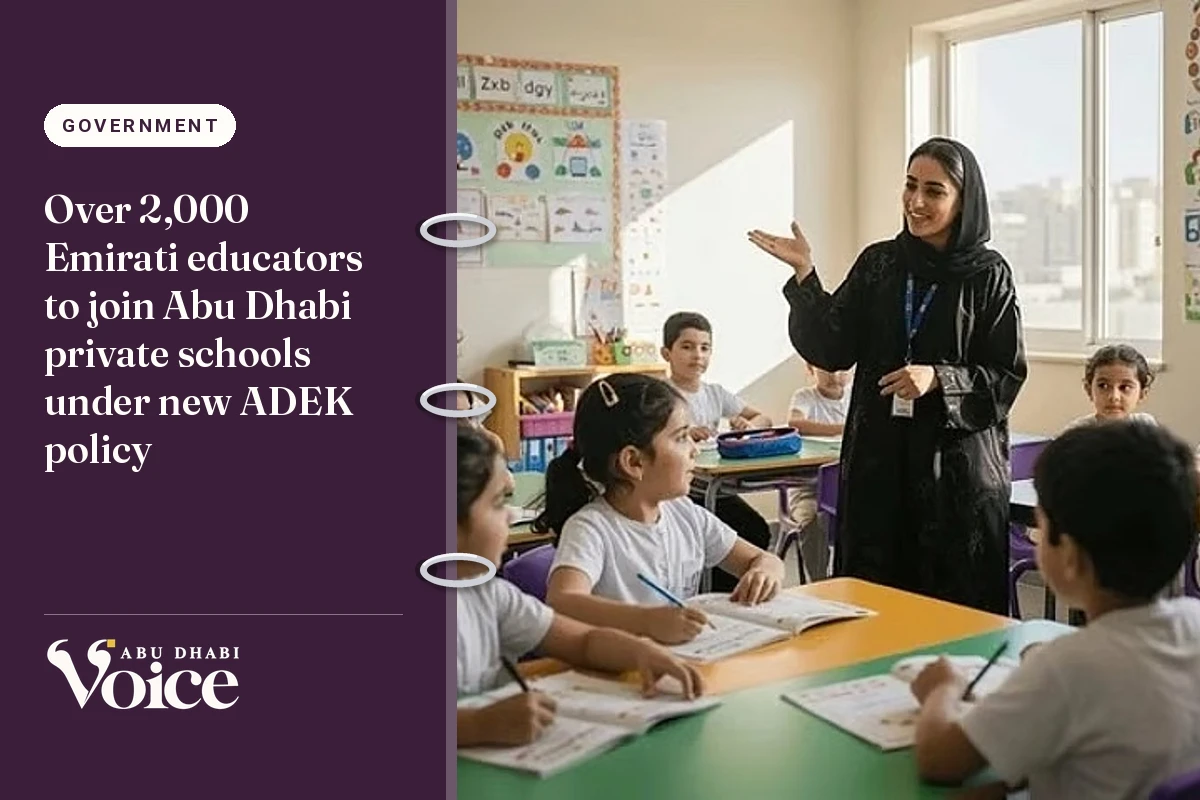
Over 2,000 Emirati educators to join Abu Dhabi private schools under new ADEK policy
Abu Dhabi’s private education sector is set to welcome more than 2,000 Emirati teachers over the next five years, following a new Emiratisation policy unveiled by the Abu Dhabi Department of Education and Knowledge (ADEK). The initiative is designed to increase the number of UAE Nationals in teaching roles across private schools in the emirate.
Policy framework and partners
The policy establishes specific Emiratisation targets for teaching positions, complementing existing federal requirements. It is backed by the Ministry of Human Resources and Emiratisation (MOHRE), the Emirati Talent Competitiveness Council (NAFIS), and five private education operators: SABIS, Taaleem, GEMS Education, International Community Schools, and Liwa Education. These partners will work together to streamline training, qualification, and employment pathways for Emirati educators.
ADEK’s priority is to build a high-quality education ecosystem led by skilled teachers. The policy aims to equip young people in Abu Dhabi with advanced life and future skills, prioritise their wellbeing, and strengthen their connection to local heritage and sense of belonging.
The new Emiratisation Policy for Private Education introduces emirate-level targets for teaching roles. It sets out a dedicated approach to increasing Emirati representation in classrooms and developing educators who reflect the values, expertise, and professional standards expected across Abu Dhabi’s education system.
Commitments and recruitment targets
The policy pairs clear expectations with support for schools, including access to screened national talent, funded qualification pathways, practical school-based training, and structured employment routes. This approach is designed to support sustainable growth in the national teaching workforce while giving schools a clearer implementation framework.
Anchoring the policy is the Abu Dhabi Educators’ Proficiency Framework, developed by ADEK and the Emirates College for Advanced Education (ECAE). The framework outlines seven core values: UAE National Identity and Cultural Respect; Integrity and Ethical Responsibility; Humility, Respect, Compassion and Community; Excellence and Intellectual Curiosity; Lifelong Learning, Resilience and Innovation; and Collaboration and Collective Responsibility.
The new partnerships build on ADEK’s May 2026 agreement with Aldar Education, which committed to creating more than 300 opportunities for Emirati educators. Under the latest commitments, Taaleem has pledged to recruit more than 200 Emirati educators, SABIS more than 150, GEMS Education more than 120, International Community Schools more than 77, and Liwa Education more than 61. The initial focus will be on Social Studies, Arabic, and Islamic Studies roles, with recruitment and integration phased over the next five years.
The operators will act as strategic partners in implementing the policy, helping to establish practical models for recruitment, training, and placement. ADEK will continue working with all private schools in Abu Dhabi to support implementation, facilitate access to national talent, and help schools progress toward the new targets.
The collaboration will also open more pathways for UAE Nationals into specialised education, while strengthening schools’ access to qualified professionals who can support inclusive learning, student wellbeing, and individualised support for Students of Determination.
Support programmes and student employment
The wider Emiratisation drive is delivered through a coordinated model involving MOHRE, ETCC, and ADEK. Central to this is NAFIS, which provides UAE Nationals with funded training, financial support, and structured pathways into sustainable private-sector careers in education. MOHRE offers the training and employment mechanisms through which candidates can join private schools and count toward applicable Emiratisation requirements.
These efforts are also supported by the Emirati Student Employment Contract programme, which allows UAE Nationals to join an employer from the start of their studies while receiving financial support, a monthly salary, pension registration, and practical on-the-job training. Participants also contribute to the employer’s Emiratisation targets.
Alongside employer demand, ADEK is building the talent supply needed to sustain the policy in the long term. Working with MOHRE and NAFIS, it identifies and prepares national talent through a range of teacher attraction and development pathways. These include Midad, a short-term programme launched earlier in 2026, which offers an entry point for UAE Nationals interested in exploring teaching, and Kon Moallim, launched in 2025, which provides promising talent with a sponsored postgraduate qualification in education. Both are designed and delivered in partnership with ECAE.
Complementing these is the newly launched Teachers Program, a flagship NAFIS initiative delivered by ECAE in partnership with ADEK. The programme aims to build a sustainable pipeline of qualified Emirati educators by lowering barriers to entry and connecting national talent with training and employment opportunities in private education. It combines specialised training, practical classroom preparation, and employment opportunities, and is open to Emirati jobseekers and those looking to move into education careers, subject to approved eligibility requirements. The Teachers Program offers two pathways—Teacher and Teacher Assistant—providing flexible entry routes for Emirati talent at different qualification levels. Through NAFIS, eligible participants on the Teacher pathway may receive a monthly financial incentive of up to Dh4,000 throughout the training period.
Through the policy, strategic partnerships, and expanding development pathways, ADEK will continue to grow the number of Emirati educators across Abu Dhabi, ensuring national talent has the preparation, qualifications, and opportunities needed to build long-term careers in education and contribute to a high-quality, values-driven, and future-ready education ecosystem.