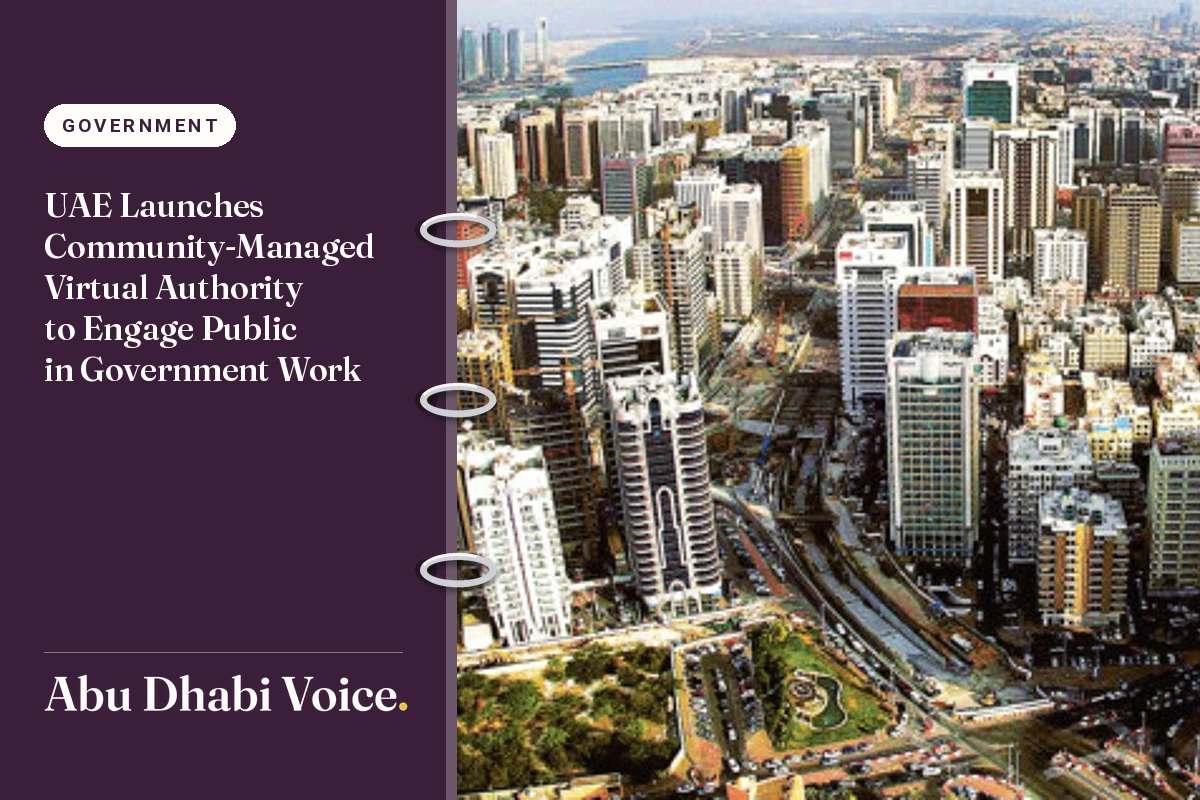
UAE Launches Community-Managed Virtual Authority to Engage Public in Government Work
Establishment and Leadership
Under the directives of President Sheikh Mohamed bin Zayed Al Nahyan, Sheikh Mansour bin Zayed Al Nahyan, Vice President, Deputy Prime Minister and Chairman of the Presidential Court, issued a resolution creating the Community-Managed Virtual Authority, which is affiliated with the Presidential Court.
In the same resolution, Sheikh Mansour appointed Sheikh Zayed bin Mohamed bin Zayed Al Nahyan as Chairman of the newly formed Authority.
Operating Framework and Guiding Principles
The Authority will operate within a flexible and non‑traditional governance framework that relies on community participation and the periodic assignment of executive management duties to skilled and experienced members of society, following controls and standards approved by the Chairman to secure efficiency, continuity and positive impact.
It will align with the UAE’s national priorities and approved strategies while preserving an innovation‑ and experimentation‑driven operating model, focusing on enabling community members to help develop and implement solutions and projects that yield sustainable national and societal value.
The Authority’s work is guided by six principles: the vision of the Founding Father, the late Sheikh Zayed bin Sultan Al Nahyan; participatory governance; community empowerment; flexibility and experimentation; sustainability and continuity; and national impact.
Functions and Responsibilities
The Authority aims to empower society members to contribute to nation‑building by creating innovative solutions and nationally valuable projects that advance development and growth, while establishing a collaborative model based on participatory governance to harness community talents.
It is tasked with developing general policies and strategies that enable community participation in creating solutions and launching national projects and programmes, attracting and investing in national talent such as youth, professionals, academics, entrepreneurs and retirees, and leveraging their expertise for the nation’s benefit.
The Authority must also set up a sustainable system for submitting solutions and proposals related to community involvement in development processes, and for documenting and transferring the knowledge and expertise generated by its work between successive teams to preserve institutional memory.
Governance Model and Operational Cycle
The Chairman of the Authority is appointed by a decision of the Chairman of the Presidential Court and is responsible for overseeing the Authority’s activities, ensuring objectives are met and aligned with national policies, approving general policies and strategies for submission to the Presidential Court’s Chairman, approving development and implementation plans for initiatives, monitoring execution, issuing internal financial and administrative regulations, and submitting the annual budget and final accounts for approval.
The Authority will follow a periodic community‑managed model, operating through a community team that includes a Director‑General and supporting teams drawn from society to manage the Authority during specified operational cycles.
The Director‑General will be selected from skilled and qualified community members for each cycle and will assume executive responsibility for contributing to the management of