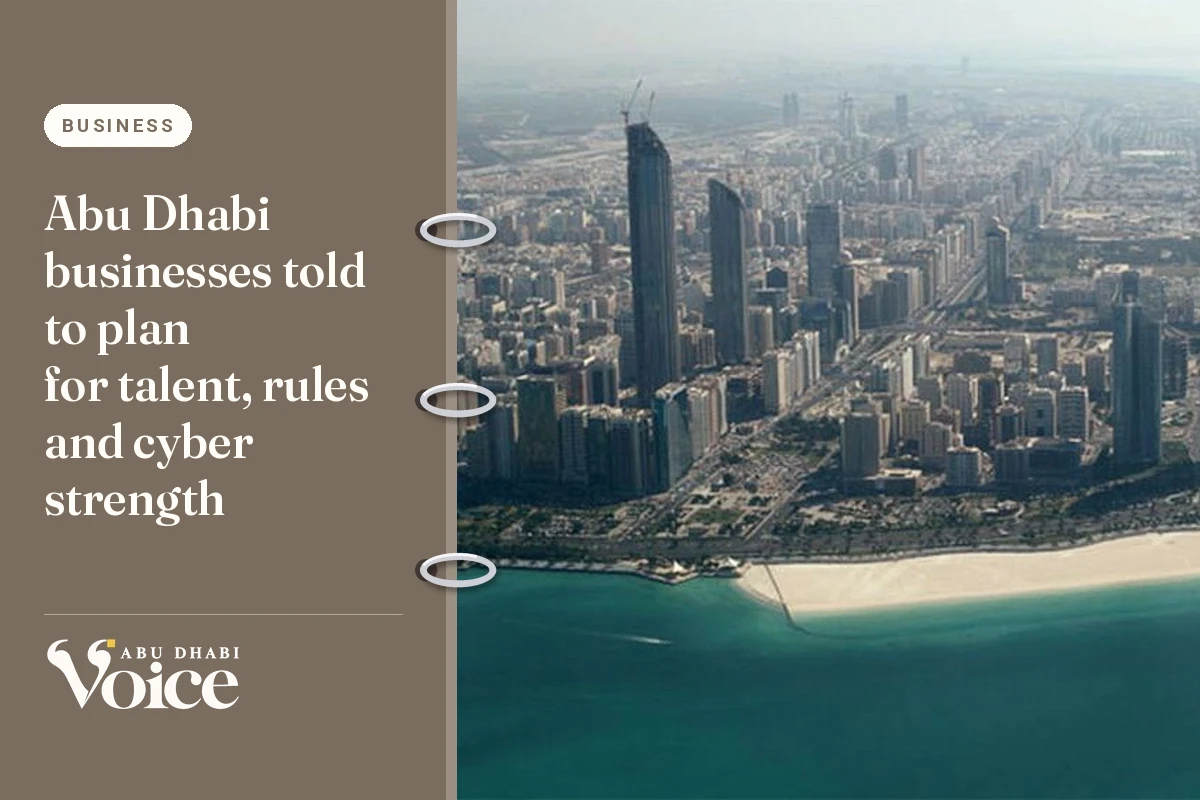
Abu Dhabi businesses told to plan for talent, rules and cyber strength
Abu Dhabi is transforming into a major institution‑led business centre, but maintaining that momentum demands that companies look beyond simply opening an office or buying technology and instead build lasting local capabilities in people, rules and digital defence.
Shifting from Visitor to Operator
Historically, international managers came to Abu Dhabi to pitch sovereign wealth funds and then returned to London or New York to manage the capital remotely. Today they are establishing offices in the capital, meaning investment decisions are made locally rather than abroad. Nagham Hassan, market analyst at eToro, noted this change, saying that Abu Dhabi Global Market (ADGM) hosted more than 190 asset and fund managers overseeing 276 funds in the first half of 2026, with the assets under management 54 percent higher than a year earlier. She added that the expansion has continued each year since 2022, indicating a structural shift rather than a one‑off surge.
Across asset management, cybersecurity and digital assets, executives interviewed by Gulf News highlighted the same trend, emphasizing that the real price of growth now lies in securing local talent, meeting regulatory requirements, strengthening infrastructure and ensuring operational resilience.
Investing in Talent, Regulation and Cyber Resilience
A permanent presence brings costs that go far beyond office rent and salaries, with cybersecurity emerging as a critical and frequently underestimated element of the investment. CPX, the Abu Dhabi-based cybersecurity firm, warns that companies often misjudge the true expense of security by concentrating on software licences and products while neglecting the people, processes and recovery capabilities that surround them. Hadi Anwar, CEO of CPX, reiterated that the most underestimated security costs are usually not the products themselves but the people, processes and recovery capabilities around them.
Anwar explained that setting up an office or purchasing new technology is merely the first step. Sustainable growth requires firms to place decision‑makers in Abu Dhabi, hire specialist teams, develop regulated functions and invest in systems that enable them to withstand market and technology shocks.
A joint study by CPX, IDC and Microsoft found that 80 percent of UAE chief information officers anticipate artificial intelligence to deliver returns within two years, while 98 percent of security teams have already encountered an AI‑related risk in live environments. Only 10 percent of organisations establish security requirements before selecting an AI product.
For those drafting 2027 budgets, Anwar said the hidden expenses of a cyber incident can include investigations, specialist assistance, legal and regulatory obligations, communications and lost business. Ongoing outlays cover staff training, continuous monitoring, recovery tests and cyber drills, and additional bills may arise from supplier, cloud‑service or AI risks if they are overlooked.
Measuring Success Beyond Tools
For existing businesses, progress should be gauged by improvements in cyber maturity—such as the speed with which threats are detected, incidents contained and critical services restored—rather than by the quantity of tools purchased or the amount spent. Anwar advised that this focus on maturity provides a clearer picture of true resilience.
The same principle applies to digital‑asset firms. Karl Naim, who leads XBTO’s Middle East operations, said that compliance, licensing and risk rules permeate every activity, from trading and custody to asset management. Each new product, client type or jurisdiction adds oversight, causing costs to rise as the business expands.
Naim pointed out that newcomers often underestimate two factors. First, the time required before any revenue appears, as firms must secure approvals, build regulated teams and pass checks. Second, the scarcity and expense of professionals who understand both financial regulation and digital assets. He advised finance leaders to model the ramp‑up conservatively, treat expert hires as a core budget line and separate fixed regulatory costs from variable growth spending, protecting the fixed layer first to retain licence and credibility regardless of market conditions, then adjusting the remainder as circumstances change.
Outlook for 2027 Budgets
Abu Dhabi has demonstrated its ability to attract global institutions. The next challenge is whether their offices in the emirate evolve into full‑scale operating centres and whether the surrounding talent, trading activity, regulatory framework and security measures become robust enough to keep that capital and capability within the city.