IMF projects UAE economy to grow 7.7% in 2027, cites strong buffers and AI readiness
The International Monetary Fund has forecast that the UAE economy will expand by 7.7% in 2027, a notable upgrade of 2.4 percentage points from its April projections. The revised outlook, presented at a press conference organised by the Dubai International Financial Centre in partnership with the IMF, highlights the country’s solid financial reserves, modern infrastructure and technological strengths as key factors that position it to seize future growth opportunities and navigate regional and global uncertainties.
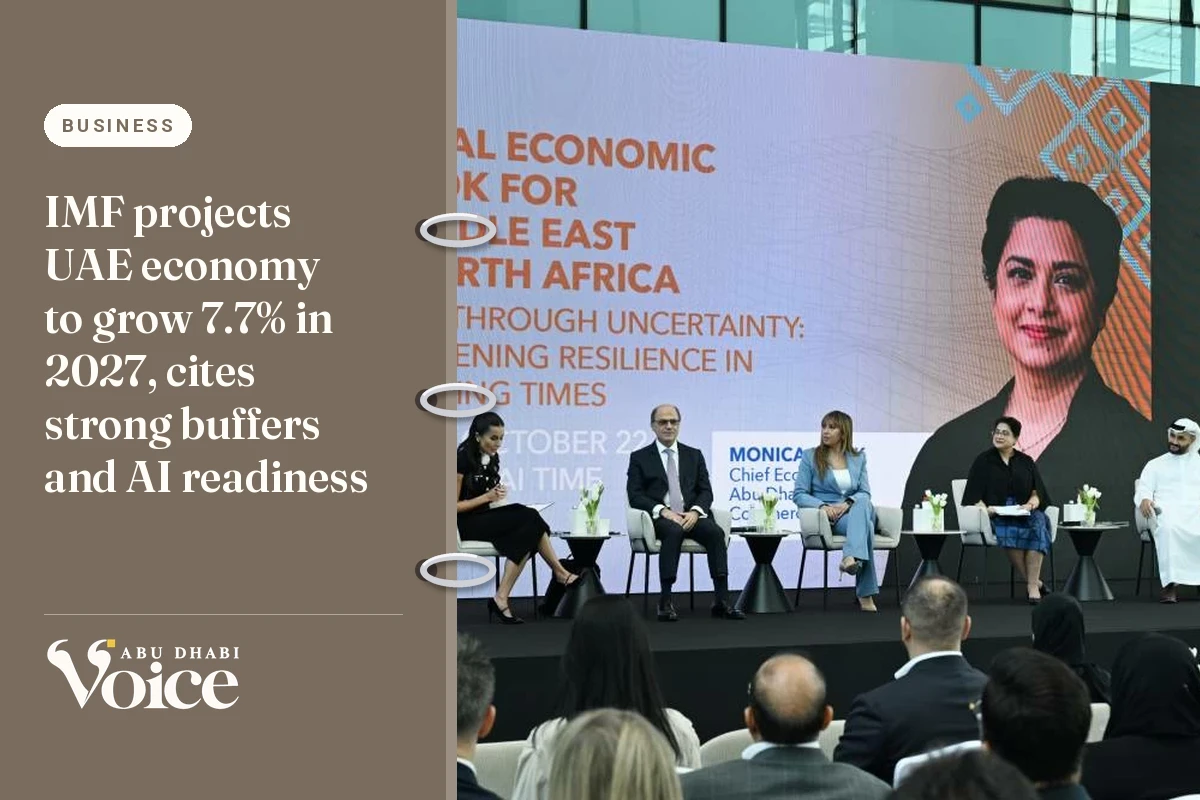
The event, held under the theme ‘Resilience in the Face of Challenges: Diverging Economic Outlooks in the Middle East and North Africa,’ featured Dr Jihad Azour, Director of the IMF’s Middle East and Central Asia Department, who outlined the main findings of the October 2026 Regional Economic Outlook for the Middle East and Central Asia. A panel discussion with policymakers, economists and private-sector leaders followed the presentation.
UAE’s financial buffers and infrastructure edge
The IMF report underscored the UAE’s ample financial buffers, which provide room to deploy fiscal measures to support economic activity when necessary, all within a credible medium‑term framework that ensures fiscal sustainability. It also stressed the importance of continued investment in infrastructure development, improving supply‑chain efficiency and maintaining business continuity.
Dr Azour noted that economies across the region have shown resilience in confronting economic crises, drawing on experience and policies honed in recent years – including steps taken during the COVID‑19 pandemic – that helped sustain economic activity, assist affected sectors and speed up recovery.
Artificial intelligence as a growth multiplier
Dr Azour said the UAE is among the countries best placed to benefit from rapid advances in artificial intelligence, thanks to its earlier investments, sophisticated infrastructure and technological capabilities. He added that sustained investment in AI could add roughly 0.5 percentage points to the UAE’s annual economic growth.
The report indicated that AI adoption could lift annual economic growth across the Middle East and Central Asia by between 0.1 and 0.6 percentage points over the medium term, with gains depending on individual countries’ readiness and ability to deploy advanced technologies. It emphasised the need for continued investment in digital infrastructure, human capital, skills training and innovation ecosystems, as well as the development of exportable AI‑based services for global markets, to boost productivity and diversify growth sources.
Inflation outlook and trade diversification
On inflation, the report projected that average inflation across the Gulf Cooperation Council countries would decline to 2.4% in 2027 and stabilise at around 2% from 2028 onward, supported by falling commodity prices and sustained fiscal discipline.
The report also stressed that diversifying exports and markets, developing alternative trade corridors and deepening economic integration are essential to strengthening the region’s resilience to external shocks. It highlighted the importance of building transport and logistics networks and improving trade connectivity between countries.
IMF support and structural reforms
The IMF emphasised that investment in education, skills development and labour market flexibility can enhance productivity and support economic diversification, alongside continued structural reforms, improvements to the investment climate and a stronger role for the private sector.
Since 2020, the IMF has approved approximately US$48 billion in financing for countries in the Middle East and Central Asia, and during fiscal year 2026 it implemented 437 technical assistance and capacity‑development projects across 31 countries as part of its efforts to promote economic stability and sustainable development.
The report concluded that leveraging global technological transformations, strengthening trade integration and diversifying economic activities would open new opportunities for countries across the region to raise productivity, attract investment and build a more solid foundation for sustainable growth in the years ahead.