Gulf shipping attacks persist as UAE airlines cancel Riyadh flights amid airport closure
Gulf maritime security remains strained as attacks on shipping continue and flight disruptions from a closed Riyadh airport affect UAE travellers, prompting airlines to adjust schedules and authorities to monitor the situation.
Maritime security and shipping attacks
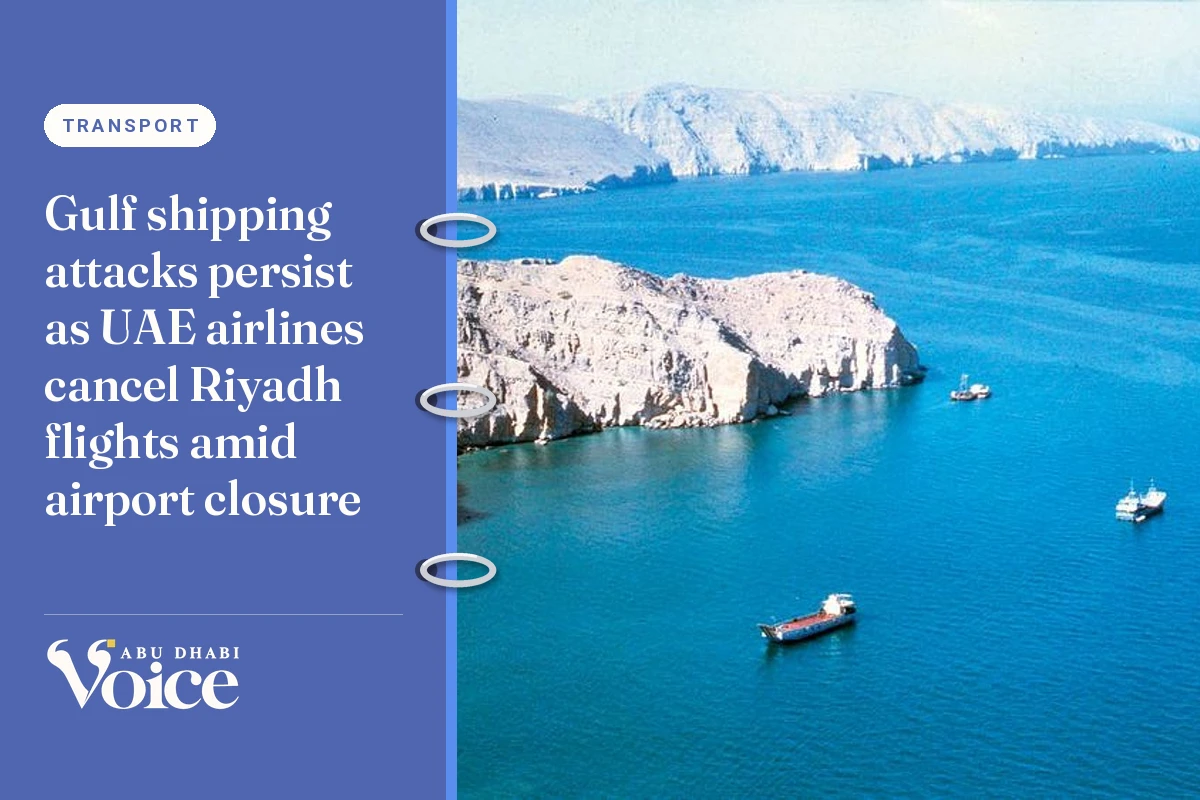
The Islamic Revolutionary Guard Corps says the container ship GFS Pride sank after striking a mine south of the Strait of Hormuz, while Singapore, where the vessel is registered, maintains that a projectile hit the ship and all 21 crew were rescued; the cause remains disputed. A second Singapore‑flagged ship, GFS Giselle, was hit on the same day but managed to leave the area under its own power. US Central Command reported that its forces destroyed an Iranian‑linked dhow in the Gulf of Oman on 6 October, stating the craft was conducting surveillance and targeting US Navy ships, though no vessel identification or further details were provided. A US military official speaking to Reuters said that after the United States degraded much of Iran’s radar capability, the IRGC began employing unarmed spotters to identify targets, noting that dhows and small craft are abundant in the waterways, giving such personnel cover among civilian traffic; this information comes from an anonymous source and has not been independently confirmed, and Iran has not commented on the claim. On 13 October, Iran’s navy announced it had deployed “operational units” east of the Strait of Hormuz and across the Gulf of Oman and Arabian Sea for real‑time monitoring of maritime traffic. According to Maritime Executive, six merchant ships were attacked on a single Sunday and four more on the following Tuesday, with the Financial Times tally indicating up to 24 vessels have been assaulted this month. Kpler data from late September shows that about 40 % of Gulf crude now bypasses the Strait of Hormuz via pipelines, compared with 17 % before the conflict. The United States Central Command insists commercial shipping continues through the strait under coordinated protection from US forces and regional partners, and that the US blockade of Iran remains fully in effect.
Flight disruptions and airport closure
The disruption is linked to the wider conflict but the direct cause is attacks on Riyadh’s airport by Yemen’s Iran‑backed Houthis. Saudi aviation authorities said an attack on 10 October killed 12 people and injured 309, while a further strike on 11 October resulted in one death and 11 injuries. King Khalid International Airport will remain closed until 2100 GMT on 17 October. More than 3,000 flights from Saudi airports were cancelled or marked no‑fly in the preceding week. Travellers should not assume that flights to other Saudi cities are automatically cancelled or operating normally simply because Riyadh is shut.
UAE airline responses and travel advice
Etihad has cancelled all Abu Dhabi‑Riyadh flights until 19 October. flydubai has suspended services to Riyadh, Dammam and Abha until 19 October, and also cancelled Neom flights on 14 and 15 October. Emirates has called off Dubai‑Riyadh flights EK815, EK817 and EK819, together with their return legs, on 14 and 15 October. Foreign carriers SWISS, Austrian, Edelweiss and Eurowings have suspended their services to Abu Dhabi through 24 October. The UAE had already halted all trade and financial transactions with Iran in August and stopped all Iran‑origin flights; the recent attacks put that late‑September recovery at risk. Passengers are advised to check their flight status on the airline’s website or app before heading to the airport, as schedules are changing day by day. Those booked to Saudi Arabia should contact their airline or travel agent about rebooking or refunds. Extra time should be allowed at Dubai and Abu Dhabi airports, where delays have been reported. Travellers should follow official UAE channels for safety guidance; this report does not cover official government advisories.